Welcome: Xiamen ZoneWu Technology Co., LTD.

qui@zonewu.com
18146178586
Ethylene oxide (ETO) is widely used in medical sterilization and chemical warehousing, featuring both high toxicity and flammability. Concentration monitoring serves as a core defense line for safe production. LoRaWAN integrated ETO temperature and humidity sensors have become the preferred choice for industrial IoT monitoring due to their advantages of wireless cable-free installation, low power consumption and long-distance transmission. However, in actual deployment, restricted by the electrochemical detection principle and improper product selection, four major pain points are highly likely to occur: data distortion, cumbersome operation and maintenance, communication disconnection, and poor scenario adaptability. Combined with practical product manuals, this article dismantles core problems and sorts out simplified key selection points to help users avoid traps and select stable and durable monitoring equipment.
1. Strong Cross-interference and Prone to Data Distortion
Electrochemical ETO sensors feature weak anti-interference capability and are easily affected by gases such as ethanol, formaldehyde and carbon monoxide. Measured data from manuals shows that 300ppm alcohol can produce an equivalent ETO reading of 155ppm, and the interference value of 10ppm formaldehyde reaches as high as 80ppm. Interference becomes more severe in high-humidity environments, often triggering false alarms and completely losing the early warning value.
2. Short Service Life, Large Drift and High Operation & Maintenance Costs
ETO gas easily poisons sensor electrodes, with a conventional service life of less than 2 years. Zero drift and reduced sensitivity tend to occur during long-term operation, requiring regular calibration. Moreover, the equipment cannot be used continuously in high-humidity condensation environments above 95%RH, otherwise the probe is prone to blockage and slow response. Frequent probe replacement and on-site calibration lead to hidden operation and maintenance costs far exceeding the equipment itself.
3. Obvious Shortcomings in Wireless Communication and Deployment
Ordinary wireless models feature short communication distance and poor wall-penetrating performance, making signal disconnection frequent in complex factory areas and medical buildings. Products with non-standard LoRaWAN protocols are incompatible with existing IoT platforms, causing difficulties in later expansion. Non-standard installation locations and power supply also lead to frequent data transmission interruptions and equipment failures.
1. Opt for Standard LoRaWAN Protocols
Prioritize products supporting multi-bands (CN470/EU868), LoRaWAN 1.0.3 version and OTAA over-the-air activation, with default Class C mode for timely uplink and downlink data interaction. A single gateway covers a wide range, enabling cable-free deployment in large-scale factory areas and medical parks with no pressure for later expansion.
2. Match Core Scenario Parameters
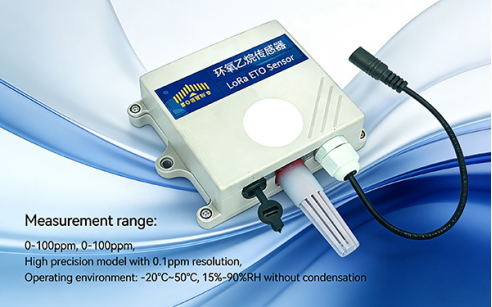
For medical sterilization residue monitoring, select high-precision models with a measuring range of 0-100ppm and 0.1ppm resolution. Ensure adaptation to operating conditions of -20℃~50℃ and 15%-90%RH (non-condensing) to avoid high-humidity environments. Prioritize integrated temperature and humidity models to eliminate the need for additional probes and realize all-in-one environmental monitoring.
3. Value Anti-interference and Stability Performance
Check cross-interference parameters during selection and prioritize models with optimized anti-interference performance. Support remote zero calibration with only one calibration every 6-12 months to reduce drift. Equipped with threshold over-limit alarm, data is reported at intervals after triggering to eliminate missed reports, and linkage with alarm devices enhances safety.
4. Low Power Consumption and Wide Voltage Power Supply for Reduced Maintenance
Select models with 5-28VDC wide voltage power supply and Type-C interface, balancing fixed installation and temporary commissioning. With a default collection cycle of 10s and reporting cycle of 5 minutes, the low-power design extends battery life and greatly reduces on-site maintenance frequency.
5. Standardized Installation and Protection Design
Since ETO is heavier than air, sensors are recommended to be installed 30-60cm above the ground, with wall-mounted installation for higher convenience. Implement proper interface protection to prevent water vapor and dust from entering the probe and prolong service life.
The core of selecting LoRaWAN ETO sensors lies in scenario adaptation, performance accuracy and full-life cycle cost consideration, without blind stacking of parameters. Focusing on the three cores of anti-interference, stable communication, service life and power consumption, and following the three key points of protocol, parameters and installation, can thoroughly solve the problems of data distortion, cumbersome maintenance and difficult deployment. This helps build a reliable ETO safety monitoring defense line and safeguard the bottom line of production safety in medical and chemical scenarios.https://www.zonewu.com/en/-Gas-Sensor.html
Contact: Qui
Phone: 18146178586
Tel: 18146178586
Email: qui@zonewu.com
Add: 1501-3, Building F03, Phase III, Software Park, Jimei District, Xiamen City, Fujian Province, China