Welcome: Xiamen ZoneWu Technology Co., LTD.

qui@zonewu.com
18146178586
In modern agricultural planting and industrial gas monitoring, precise control of ethylene concentration has become increasingly critical. As a natural plant hormone, ethylene acts as an "invisible regulator" in the ripening and fresh-keeping storage of fruits and vegetables. Insufficient concentration results in poor ripening effects, while excessive concentration causes over-ripening and rot, leading to substantial economic losses. In petrochemical, chemical and other industries, ethylene is a flammable and explosive gas, making its leakage monitoring a bottom line for safe production.
Against this backdrop, RS485 ethylene sensors have gradually become the mainstream choice in gas monitoring thanks to their advantages of high stability, strong anti-interference performance and support for long-distance transmission.
Traditional analog sensors (such as 4-20mA and 0-10V) are prone to signal attenuation and electromagnetic interference during long-distance transmission. In contrast, RS485 adopts differential signal transmission, delivering excellent anti-interference capability with a transmission distance of over 1,200 meters. More importantly, RS485 supports the Modbus RTU protocol, allowing one host to connect multiple sensors simultaneously, facilitating the construction of distributed monitoring networks. It easily meets the needs of layered deployment in large cold storage facilities and multi-point monitoring in controlled atmosphere storage for fruits and vegetables.
RS485 ethylene sensors typically adopt high-precision electrochemical or semiconductor detection principles, with measuring ranges covering 0-10ppm, 0-100ppm and higher concentrations to suit various scenarios.
In agricultural applications, during the cold-chain transportation of fruits and vegetables, sensors transmit real-time ethylene concentration data to cloud platforms via PLC or IoT Gateways. When concentrations exceed preset thresholds, the system automatically activates ventilation or ozone removal equipment to maintain ethylene within optimal ranges, effectively extending the fresh-keeping period of produce.
In industrial settings, these sensors serve a critical safety monitoring role. In the event of ethylene leakage, the monitoring system immediately triggers audible and visual alarms and shuts off relevant valves, minimizing accident risks. Such sensors have become a standard configuration for safety production standardization in many chemical industrial parks.
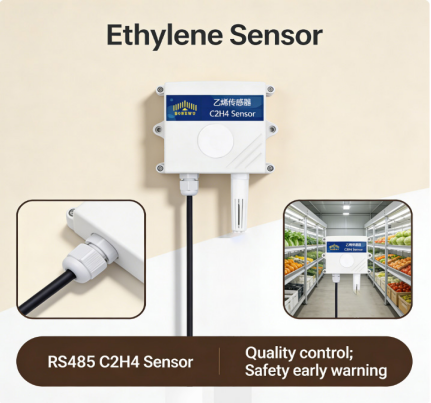
When selecting RS485 ethylene sensors, focus on the following aspects:
1. Measurement accuracy and stability: Prioritize products with temperature compensation to prevent data drift caused by changes in ambient temperature and humidity.
2. Protection rating: For humid agricultural cold storage or outdoor environments, an IP65 or higher protection rating is recommended for reliable performance.
3. Communication protocol compatibility: Verify that the sensor’s Modbus RTU protocol matches the host computer system to avoid integration difficulties.
During installation, place sensors in well-ventilated locations representative of the monitored area, avoiding air vents and dead corners. For multi-sensor networking, assign unique Modbus addresses to prevent communication conflicts.
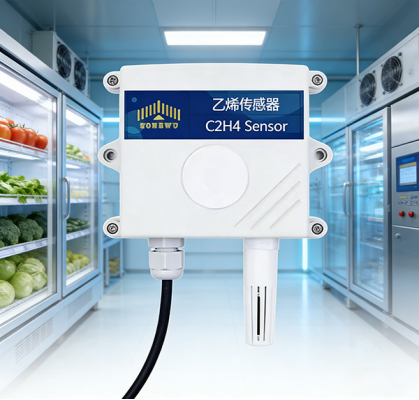
During operation, regularly clean the sensor probe to prevent dust and oil fouling from affecting detection accuracy. Install sensors away from strong electromagnetic interference sources and corrosive gases, and ensure adequate ventilation. Perform zero-point calibration regularly, preferably every 6 to 12 months, to maintain long-term measurement accuracy. Use shielded cables for wiring to reduce signal interference and extend transmission distance.
With the rapid development of the Industrial Internet of Things (IIoT), demand for intelligent and precise gas monitoring continues to rise. Featuring stable communication, accurate detection and wide compatibility, RS485 ethylene sensors serve as core equipment in industrial monitoring, providing robust support for safe production and quality control across industries, and enabling intelligent and efficient operations.https://www.zonewu.com/en/-Gas-Sensor.html
Contact: Qui
Phone: 18146178586
Tel: 18146178586
Email: qui@zonewu.com
Add: 1501-3, Building F03, Phase III, Software Park, Jimei District, Xiamen City, Fujian Province, China