Welcome: Xiamen ZoneWu Technology Co., LTD.

qui@zonewu.com
18146178586
Dissolved oxygen (DO) is one of the core indicators for evaluating water quality in aquaculture, wastewater treatment, environmental monitoring and other fields. With the advancement of IoT technology, LoRaWAN wireless dissolved oxygen sensors have become the industry mainstream thanks to their low power consumption, long transmission range and easy deployment. However, with a wide range of devices featuring different working principles and parameters on the market, how to pick the right one? This guide summarizes five key selection tips to help you make a wise decision.
Most conventional dissolved oxygen sensors adopt the electrochemical or polarographic method. They consume oxygen and require electrolyte replenishment, while their membrane heads are prone to contamination and demand frequent maintenance.
In contrast, optical fluorescence sensors work based on the fluorescence quenching principle. They consume no oxygen and need no electrolyte, featuring fast response, low signal drift and minimal maintenance. A high-quality fluorescent membrane can serve for up to one year, greatly cutting operation and maintenance costs. The fluorescence type is highly recommended, especially for long-term online monitoring scenarios.
LoRaWAN is an ideal solution for scenarios with scattered monitoring points, no mains power and difficult wiring, such as fish ponds, rivers and wastewater treatment plants. It delivers kilometer-level transmission distance, low power draw and strong penetration capability. Compliant with standard LoRaWAN protocols (Class A, OTAA activation), the sensors can be quickly connected to mainstream IoT platforms.
Unlike 4G or NB-IoT devices, LoRaWAN sensors require no SIM cards or data service fees. Compared with RS485 wired solutions, they save substantial wiring costs. When selecting products, verify that the supported frequency bands (CN470, EU868, US915, etc.) are compatible with local gateways.
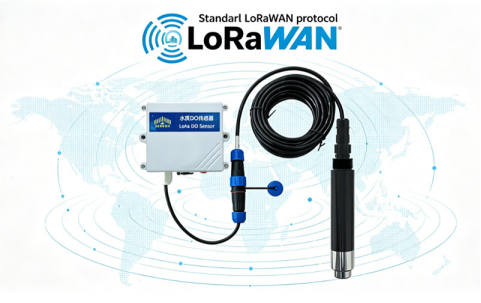
These sensors are generally equipped with high-capacity lithium thionyl chloride batteries (e.g. 8500 mAh). With a default data reporting interval set between 10 and 60 minutes, the battery can last up to 2 years.
Note that dissolved oxygen sensors have relatively high power consumption. Too short a reporting interval (e.g. every few minutes) will lead to rapid battery drain. If high-frequency data collection is required, choose models with external power supply or solar power support. Assess on-site power conditions and real-time data requirements in advance to set a reasonable reporting cycle.
· Measuring Range: The standard range of 0~20 mg/L (0~200% saturation) covers most freshwater and seawater application scenarios.
· Accuracy: Typical accuracy reaches ±3% FS with a resolution of 0.01 mg/L. Built-in temperature compensation of ±0.5 ℃ ensures stable and reliable measurement data.
· Model Classification: Distinguish between freshwater and seawater versions. Salinity greatly affects dissolved oxygen readings, so select the correct version according to the actual water body.
The fluorescent membrane head must be protected from collision, scratches and contact with organic solvents. Keep the sensor submerged below the water surface during operation, and clean it every 30 days as recommended.
The device shall support zero-point calibration and atmospheric pressure configuration. Routine calibration is suggested every 3 months for long-term use. For storage, keep the fluorescent membrane moist at temperatures above 0 ℃. The minimum temperature for dry storage is -10 ℃, and the membrane needs to be soaked in water for 48 hours to restore performance before reuse.
Prior to purchase, confirm the product is equipped with user-friendly calibration tools and PC configuration software. Most models adopt Type-C connection for intuitive parameter setup.
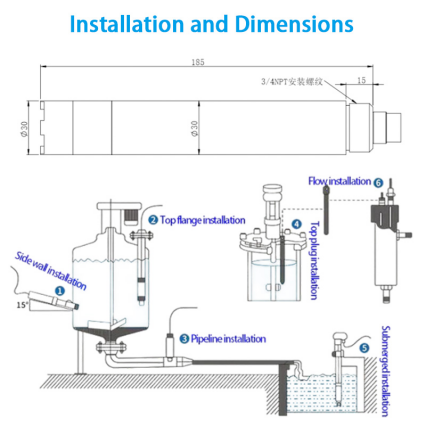
To select a qualified LoRaWAN dissolved oxygen sensor, focus on five core aspects: fluorescence measuring principle, LoRaWAN communication compatibility, balanced battery life and reporting interval, applicable range, accuracy and environmental adaptation, as well as easy maintenance and calibration.
If you are planning distributed water quality monitoring projects without mains power, such as fishery farming and environmental monitoring, use the above five criteria to compare different products. This will help you avoid frequent maintenance and invalid data issues in later operation.
Contact: Qui
Phone: 18146178586
Tel: 18146178586
Email: qui@zonewu.com
Add: 1501-3, Building F03, Phase III, Software Park, Jimei District, Xiamen City, Fujian Province, China