Welcome: Xiamen ZoneWu Technology Co., LTD.

qui@zonewu.com
18146178586
Methane (CH₄), the primary component of natural gas and biogas, is a clean energy source yet highly flammable and explosive hazardous gas. In sites such as coal mines, gas pipelines and chemical parks, methane leaks may trigger severe safety incidents including explosions and suffocation. Faced with a wide array of methane detection devices on the market, how to make the right selection? The core principle is: prioritize sensor selection before matching auxiliary functions.
https://www.zonewu.com/en/product/LoRaWAN-CH4-Sensor.html
The sensor acts as the "heart" of a detector. Sensors with different working principles vary drastically in accuracy, service life and applicable scenarios. Three mainstream methane sensor types are available on the market:
Catalytic Bead Sensors The mainstream choice for explosion-proof industrial applications, featuring fast response speed and moderate cost, designed to measure 0~100% LEL (Lower Explosive Limit). However, it has obvious drawbacks: it requires an oxygen-rich environment, and is prone to poisoning and malfunction by sulfides, silicon vapor and other substances, with a service life of only 1 to 3 years. Suitable for regular explosion-proof sites such as underground coal mines and natural gas stations.
NDIR (Non-Dispersive Infrared) Sensors It detects methane by measuring the characteristic infrared light absorption of methane molecules at specific wavelengths. Capable of measuring both low and high gas concentrations, it operates independent of oxygen supply, resists sensor poisoning and requires infrequent calibration, boasting a service life of over 5 years. Ideal for high-demand scenarios including trace leak inspection of municipal pipelines, landfills and confined spaces.
Metal Oxide Semiconductor (MOS) Sensors Compact, low-power and cost-effective, yet low in measurement accuracy and highly susceptible to temperature and humidity interference. Only applicable for qualitative household detection scenarios such as residential kitchens.
For industrial safety monitoring, NDIR infrared sensors are the top pick, thanks to outstanding stability, long service life and low maintenance costs, delivering superior long-term cost performance.
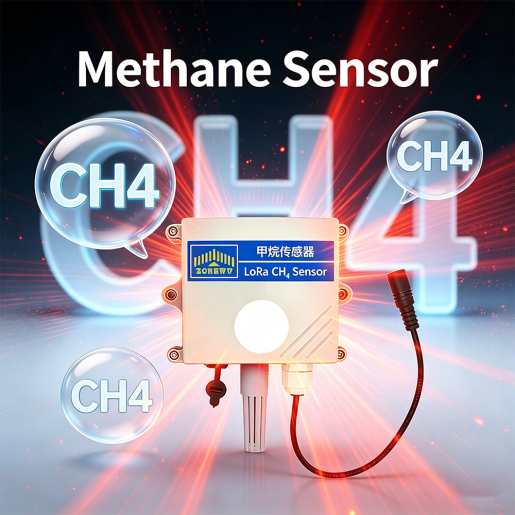
After confirming the sensor type, verify that the detection measuring range fits your site requirements. Explosion-risk sites (coal mines, chemical plants) require a 0~100% LEL range focused on monitoring explosive limits; municipal pipeline trace leak inspection demands infrared detectors sensitive to ultra-low concentration leaks. Take NDIR non-dispersive infrared products as an example: they cover a measuring range of 0~100% LEL with a resolution of 1% LEL. Built-in temperature and humidity sensors deliver an operating temperature range of -40℃ to +80℃ with temperature accuracy of ±0.3℃, fully meeting continuous industrial monitoring standards. Their sensor service life exceeds 5 years, far outperforming the 1–3 year lifespan of catalytic bead sensors.
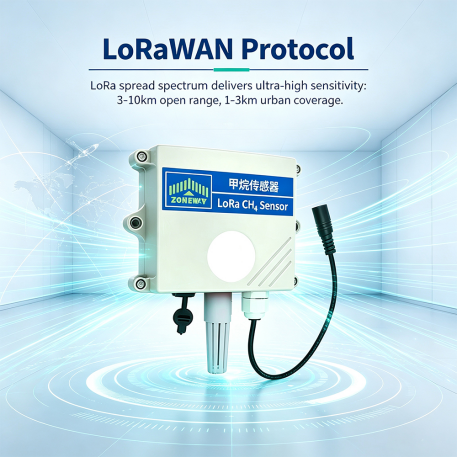
With the advancement of IoT technology, basic standalone alarm functions can no longer meet modern safety management standards. LoRaWAN-enabled wireless methane detectors support kilometer-level long-distance data transmission, remote monitoring and real-time early warning. These devices support 8 global frequency bands including CN470, US915 and EU868, adopt secure OTAA activation and Class C low-power working mode. An intelligent alarm system is integrated: once gas concentration exceeds upper/lower thresholds, the device uploads alarm notifications three times at 10-second intervals, and sends three recovery alerts after concentrations return to normal levels, effectively eliminating missed and false alarms. Both data reporting and sampling cycles can be flexibly configured via Type-C serial ports to accommodate different monitoring frequency demands.
The core logic for methane detector selection follows a step-by-step sequence: Application Scenario → Sensor Type → Technical Parameters → Functional Configuration. For industrial safety applications, opt for NDIR infrared sensors paired with LoRaWAN wireless communication and intelligent alarm functions to build a long-term stable, remotely controllable methane monitoring solution. Choosing appropriate equipment converts invisible gas hazards into readable, analyzable and actionable safety safeguards.https://www.zonewu.com/en/-Gas-Sensor.html
Contact: Qui
Phone: 18146178586
Tel: 18146178586
Email: qui@zonewu.com
Add: 1501-3, Building F03, Phase III, Software Park, Jimei District, Xiamen City, Fujian Province, China