Welcome: Xiamen ZoneWu Technology Co., LTD.

qui@zonewu.com
18146178586
With the rapid penetration of the Internet of Things (IoT) across all industries, gas monitoring has shifted from a basic necessity to a matter of optimized selection. When picking a LoRaWAN H₂S sensor integrated with temperature and humidity measurement, product datasheets alone are far from sufficient for proper selection. A poor choice will either lead to unnecessary budget waste due to overspecified performance, or result in missed alarms and false alerts at critical moments. Below is a breakdown of core selection criteria from key dimensions.
This sensor comes with two range options: 0–10 ppm and 0–100 ppm. Your selection should be determined by the target monitoring environment.
· The 0–10 ppm variant fits high-sensitivity applications such as sewage treatment plants, landfills and restroom odor monitoring. Hydrogen sulfide concentrations in these sites generally stay below single-digit ppm levels, requiring detection of trace concentration fluctuations. It delivers a resolution of 0.01 ppm to accurately capture early-stage gas leaks.
· The 0–100 ppm model targets industrial safety scenarios including petrochemical facilities, confined-space operations and livestock farms, where H₂S levels may surge to high concentrations abruptly. Its 0.1 ppm resolution meets early warning requirements while offering ample measuring headroom.
Selection Tip: If uncertain about the range, prioritize the 0–10 ppm model. It provides superior sensitivity, and most environmental monitoring sites do not see concentrations exceeding 10 ppm.

The sensor accepts wide-range 5–28 V DC input, yet deployment feasibility is the core factor to weigh during selection.
· DC-powered versions suit fixed locations with stable mains power, such as equipment rooms, power distribution stations and factory workshops. The major benefit is maintenance-free continuous operation with no battery replacement cycles.
· Battery-powered units are ideal for off-grid outdoor sites: remote utility tunnels, agricultural greenhouses and temporary monitoring stations. Leveraging LoRaWAN’s ultra-low power consumption, they enable multi-month to multi-year deployment without on-site servicing.
Selection Tip: Opt for battery-powered models for new projects for maximum installation flexibility. For retrofitting projects with existing wiring infrastructure, DC-powered variants deliver better cost efficiency.
This often-overlooked parameter plays a decisive role in device performance. The sensor defaults to Class C and supports switching to Class A mode.
· Class C maintains constant downlink channel listening, delivering millisecond-level minimal latency. It is recommended for scenarios requiring real-time remote command delivery, such as remote zero calibration and emergency threshold adjustments, at the cost of slightly higher power draw.
· Class A only opens short receive windows right after data uplink transmission, resulting in longer downlink latency ranging from seconds to minutes. It is designed for regular data logging use cases like daily environmental quality reporting and trend analysis, with drastically reduced power consumption to extend service life.
Selection Tip: Pick Class C if remote control functionality is required; select Class A for pure data collection to maximize battery lifespan.
Two frequently overlooked yet vital functions are independent upper/lower threshold trigger reporting and linkage with the built-in buzzer alarm. This sensor supports configurable upper and lower concentration limits. Once H₂S readings exceed preset thresholds, the device sends three consecutive alarm packets at 10-second intervals to help the cloud platform distinguish genuine leaks from transient noise. Its integrated buzzer delivers loud on-site audio alerts upon over-limit detection, creating dual protection combining remote cloud notifications and local audible warnings. The buzzer automatically silences once gas concentrations return to normal to avoid persistent false alarms.
Selection Tip: Verify that the sensor supports separate upper/lower threshold configuration and adjustable buzzer activation. Units with built-in buzzers eliminate extra wiring work; simply confirm the alarm sound pressure level meets noise conditions at your job site.
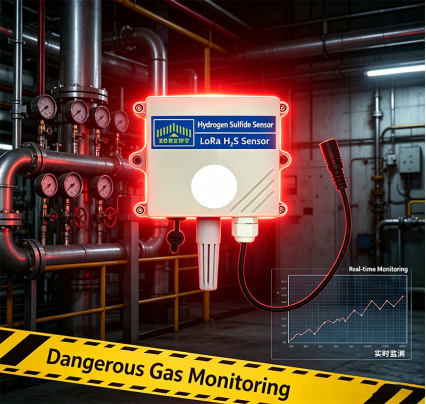
Sensor selection is not a competition of superior technical specs, but a process of matching hardware capabilities to on-site operational demands. Your choice will be reliable as long as you clarify five core factors: measuring range, power deployment scheme, LoRaWAN operation class, threshold alarm logic and zero calibration functions. If doubts remain after review, contact the manufacturer to request sample units for field testing — real measured data offers the most trustworthy reference.
Contact: Qui
Phone: 18146178586
Tel: 18146178586
Email: qui@zonewu.com
Add: 1501-3, Building F03, Phase III, Software Park, Jimei District, Xiamen City, Fujian Province, China