Welcome: Xiamen ZoneWu Technology Co., LTD.

qui@zonewu.com
18146178586
In smart city, industrial IoT and environmental monitoring sectors, noise data has become an essential monitoring indicator. Whether it is occupational health compliance in factory workshops, handling noise disturbance complaints in residential areas, or remote supervision of construction sites, a stable, easy-to-deploy and high-precision noise sensor is the key to project success. With a wide variety of products on the market, how to quickly pick the right one? This article analyzes the core factors for product selection.
The first step of selection is to define the noise range of the application scenario. The noise level in regular office areas is about 40~60 dB, busy urban roads 70~85 dB, and industrial workshops 90~110 dB. The instantaneous peak noise of stamping, cutting and other processes can exceed 120 dB.
A qualified LoRaWAN noise sensor shall feature a measuring range of 30 dB to 130 dB, a resolution of 0.1 dB, and a frequency response covering 20 Hz to 12.5 kHz, which can meet the monitoring demands of most scenarios from residential environments to heavy industry. Products equipped with high-sensitivity condenser microphones deliver stable signals and excellent linearity, minimizing frequent calibration work.
Noise monitoring points are usually scattered and located in remote areas, such as substations, waste stations, tunnels and factory peripherals, where Wi-Fi or 4G signals are often unavailable. Wired solutions incur high cabling costs, while Zigbee and Bluetooth have limited transmission distance. LoRaWAN boasts outstanding advantages as follows:
· Long transmission range: A single gateway can cover a radius of 2 to 5 kilometers in urban areas, and over 10 kilometers in open areas.
· Ultra-low power consumption: It can operate on batteries for several years. It also supports wide voltage power supply from DC 5 V to 28 V for long-term continuous operation.
· Strong penetration: Its diffraction performance outperforms 2.4 GHz signals, making it ideal for deployment in underground pipe corridors and multi-story buildings.
· Universal open standard: It supports global frequency bands including CN470, IN865, EU868 and US915, as well as OTAA network access, and is compatible with mainstream LoRaWAN network servers.
Users with existing LoRaWAN infrastructure can connect the sensors directly without purchasing additional gateways.
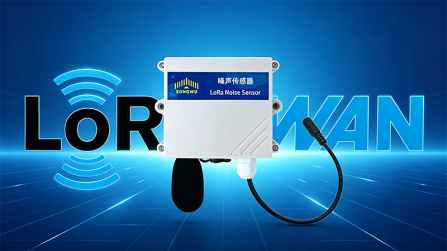
Most outdoor and high-altitude monitoring points have limited access to mains power. Premium sensors are equipped with a DC power port (5.5×2.1 mm, wide voltage: 5~28 V) and a Type-C interface, which supports both serial port configuration and temporary power supply. The sensors can be deployed independently with solar panels or 12 V storage batteries.
Weighing approximately 150 grams, the lightweight device supports wall mounting and pole mounting. A single worker can finish the installation easily, effectively cutting construction costs.
Device configurability is easily overlooked during selection. It is recommended to choose sensors that support PC connection via USB-C. Users can set DevEUI, AppEUI, AppKey, data reporting interval (adjustable from 1 second to 65535 seconds) and working modes (Class A / Class C) through free official configuration tools.
Remote downlink commands are available to modify the reporting interval or reboot devices remotely, eliminating the need for on-site maintenance at heights. Built-in LED indicators show the network access status via different flashing patterns for intuitive status checking.
Uplink data adopts a concise hexadecimal format: Address + Command Type + Data Length + Noise Value (2 bytes). For example, the data frame "05 07 02 02C9" can be parsed as follows: the hexadecimal value 0x02C9 equals 713, representing a noise level of 71.3 dB.
Developers can parse the data efficiently and push it to mainstream platforms such as Alibaba Cloud, ThingsBoard and self-built SCADA systems. The sensor also supports register reading similar to Modbus protocol for easy system integration.
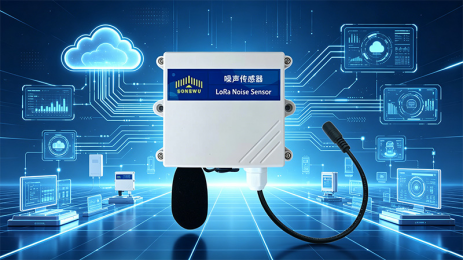
· Projects requiring long-distance transmission, low power consumption and wiring-free noise monitoring;
· Parks, factories, urban roads, schools and hospitals with existing or planned LoRaWAN gateways;
· Scenarios demanding high precision (0.1 dB resolution), wide measuring range (30~130 dB) and cost-effective solutions;
· Operation and maintenance teams that prefer remote configuration and firmware updates to reduce on-site work.
If your monitoring points are scattered, power access is difficult, and connection to IoT platforms is required, LoRaWAN noise sensors are a cost-effective choice. Simply confirm that the gateway frequency band matches local regulations, and you can quickly build a stable and scalable noise monitoring network.
https://www.zonewu.com/en/IoT-sensor.html
Contact: Qui
Phone: 18146178586
Tel: 18146178586
Email: qui@zonewu.com
Add: 1501-3, Building F03, Phase III, Software Park, Jimei District, Xiamen City, Fujian Province, China