Welcome: Xiamen ZoneWu Technology Co., LTD.

qui@zonewu.com
18146178586
In the fields of environmental monitoring and industrial safety, sulfur dioxide (SO₂) is a prevalent atmospheric pollutant. Accurate monitoring of SO₂ is directly tied to environmental compliance and occupational health. With a wide array of sensor products available on the market, making a scientific selection stands as the top priority for procurement specialists and engineering technicians. Starting from practical application scenarios, this guide sorts out five core dimensions for SO₂ sensor selection.
The first step of selection is defining monitoring objectives. SO₂ monitoring scenarios fall into two main categories. The first covers low-concentration environmental monitoring, including urban air quality monitoring stations and industrial park perimeter monitoring, which generally requires detection of SO₂ concentrations ranging from 0 to 20 ppm. The second refers to industrial emission monitoring such as flue gas desulfurization at power plants and chemical production workshops, which imposes stricter requirements on sensor sensitivity and environmental resistance.
In addition, the TLV-TWA (8-hour time-weighted average exposure limit) of SO₂ is 2 ppm, while the TLV-STEL (15-minute short-term exposure limit) is 5 ppm. When selecting sensors, ensure the detection lower limit can capture concentrations below safety threshold values.
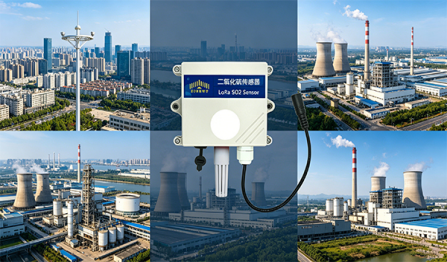
Two mainstream technical routes are adopted for SO₂ sensors: electrochemical and optical sensors. Electrochemical sensors operate based on electrochemical reaction principles. After SO₂ gas molecules enter the sensor cavity, redox reactions take place on electrode surfaces, generating weak electric current signals proportional to gas concentration. Their core strengths are high sensitivity and ultra-low power consumption. For instance, a certain LoRaWAN SO₂ sensor boasts an average power consumption of merely 0.18 W, making it ideal for battery-powered wireless monitoring nodes. Nevertheless, electrochemical sensors are susceptible to temperature and humidity fluctuations, so compensation algorithms are required to sustain measurement precision.
Optical sensors (e.g., Nondispersive Infrared / NDIR sensors) rely on infrared absorption principles. They feature strong anti-interference performance and outstanding long-term stability, suitable for harsh industrial environments with heavy dust and high concentrations of corrosive gases. However, they consume more power and come with higher upfront procurement costs. For most conventional environmental monitoring and industrial safety applications, electrochemical sensors deliver a cost-effective solution with superior sensitivity and low power draw.
Pay close attention to the following technical indicators during product selection:
· Measurement Range & Resolution: A finer resolution enables identification of minor concentration variations. For low-concentration monitoring, prioritize models with ultra-low detection limits and high resolution.
· Response Time: This metric determines the timeliness of system alarms. Electrochemical SO₂ sensors normally achieve a T90 response time within 60 seconds.
· Sensor Service Life: The electrolyte inside electrochemical sensors depletes gradually, resulting in a typical service life of around 2 years. Factor the replacement cycle into overall maintenance costs during selection.
· Anti-Interference Performance: Industrial sites often contain cross-interfering gases such as hydrogen sulfide and ammonia. Verify the sensor’s selectivity specifications before purchase.
Sensor output modes dictate compatibility with upper-layer management systems. Traditional wired solutions adopt 4-20 mA or RS485 interfaces, designed for connection with PLCs and industrial control systems. With the advancement of IoT technology, LoRaWAN wireless transmission has become an industry standard for environmental monitoring. It delivers low power consumption, wide signal coverage and wiring-free deployment, perfectly fitting large-scale distributed monitoring deployments.
The integrated LoRaWAN SO₂ temperature and humidity sensor combines an electrochemical SO₂ cell with a temperature-humidity probe, simultaneously outputting three sets of measurement data:
1. SO₂ concentration: 0–20 ppm, resolution 0.1 ppm
2. Temperature: -40 ℃ to +80 ℃, accuracy ±0.3 ℃
3. Humidity: 0–99.9 %RH, accuracy ±2 %RH
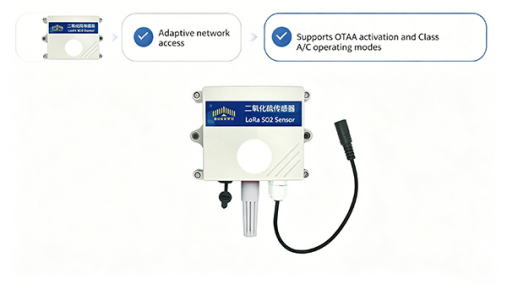
The device supports OTAA activation and Class A / Class C operating modes. Its default data upload interval is 5 minutes with a 10-second data sampling cycle. Remote downlink commands allow flexible reconfiguration of upload intervals, gas concentration alarm thresholds and sampling cycles. Such customizable functionality drastically reduces on-site operation and maintenance workload.
The installation environment directly impacts measurement accuracy. Standard operating parameters for SO₂ sensors cover a temperature range of -20 ℃ to 50 ℃ and humidity from 15 %RH to 90 %RH (non-condensing). Signal drift may occur under high-humidity conditions, so confirm whether the product is equipped with built-in humidity compensation algorithms. Furthermore, avoid installing sensors in poorly ventilated dead zones or areas with excessive airflow, which can dilute gas concentrations or produce abnormally high readings.
Selecting an SO₂ sensor essentially means striking an optimal balance among monitoring demands, technical characteristics, site environmental conditions and budget constraints. Before finalizing a model, fully assess the concentration range, ambient temperature and humidity, and communication infrastructure of target monitoring sites. Prioritize integrated sensor solutions featuring high-sensitivity electrochemical detection, LoRaWAN wireless connectivity and multi-parameter measurement capabilities. Meanwhile, incorporate calibration cycles and component replacement expenses into long-term operation and maintenance planning. Only in this way can each monitoring node serve reliably as a sentinel for ambient air quality.https://www.zonewu.com/en/-Gas-Sensor.html
Contact: Qui
Phone: 18146178586
Tel: 18146178586
Email: qui@zonewu.com
Add: 1501-3, Building F03, Phase III, Software Park, Jimei District, Xiamen City, Fujian Province, China