Welcome: Xiamen ZoneWu Technology Co., LTD.

qui@zonewu.com
18146178586
In the fields of industrial safety and environmental monitoring, methane, as a significant combustible gas, makes its leak detection directly related to the protection of life and property, as well as the continuity of production. With the in-depth development of the Industrial Internet of Things, traditional 4-20mA analog signal output methods are facing an urgent need for digital upgrade. Methane sensors equipped with RS485 digital signal output, leveraging their long-distance transmission capabilities, high anti-interference performance, and plug-and-play intelligent features, are redefining the underlying architecture of global industrial gas monitoring networks.
Digital Core: From "One-Way Transmission" to "Intelligent Networking"
The RS485 interface has become the universal language in the international industrial automation field due to its robust support for multi-point communication and long-distance transmission. A new generation of RS485 output methane sensors typically uses the standard Modbus-RTU protocol, capable of connecting up to 32 devices in series on a single twisted pair cable, with communication distances easily exceeding 1200 meters. This means that whether in underground utility tunnels stretching several kilometers or in complex chemical plant areas, monitoring personnel can build low-cost distributed sensor networks without laying extensive cabling.
Compared to the drawbacks of analog signals, which are susceptible to electromagnetic interference and require additional acquisition cards, RS485 sensors output digital signals directly and are inherently compatible with PLCs, DCS, and industrial control gateways. They fundamentally solve issues like impedance mismatch and zero drift during signal conversion, ensuring that every data point read by the monitoring center is a true reflection of the on-site concentration.
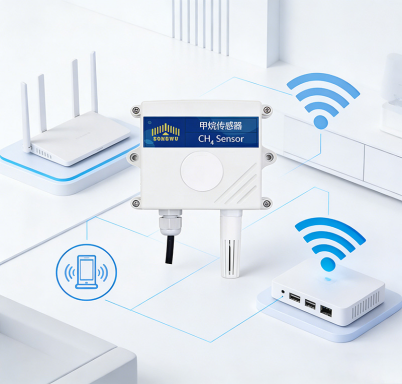
Empowering All Scenarios: From Mine Galleries to Smart Agriculture
The technological advancement of RS485 methane sensors is fostering their implementation in diverse international markets:
Coal and Non-Coal Mines: On the "lifeline" of gas control, mining laser methane sensors upload real-time concentration data to safety monitoring systems via the RS485 interface. Utilizing TDLAS laser absorption spectroscopy technology, they achieve measurement accuracy up to ±0.06% or higher, featuring resistance to water vapor and dust contamination, maintaining signal stability even in harsh underground environments.
Urban Underground Pipelines: In confined spaces like underground utility tunnels and sewage tanks, sensors can monitor methane accumulation risks in real-time. The RS485 interface enables direct "communication" between the sensor and ventilation linkage systems. Once the concentration exceeds a threshold, the system can automatically start or stop fans, nipping potential hazards in the bud.
Petrochemical Industry & Gas Stations: In areas with high explosion-proof requirements, such as natural gas gate stations and CNG/LNG stations, RS485 sensors with Ex d IIC T6 explosion-proof certification are standard. They are not only responsible for leak detection but also transmit equipment status and fault diagnosis information back to the central control room via the RS485 bus, enabling predictive maintenance.
Green Agriculture & Landfills: In landfill gas recovery and utilization projects, sensors networked via RS485 generate methane concentration distribution heat maps, helping operators optimize gas collection efficiency and turn waste into wealth.
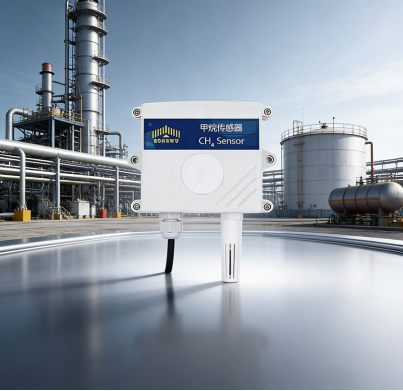
Calibration-Free & Intelligence: A Revolution in User Experience
For international clients, ease of use and maintenance costs are equally critical considerations. Current mainstream RS485 methane sensors are evolving towards "calibration-free" and "hot-swappable" features. Many manufacturers adopt a modular design; sensors undergo high and low-temperature humidity compensation and multi-level standard gas calibration before leaving the factory. Users can simply connect power and the RS485 bus to read standard concentration data without secondary development.
Furthermore, some high-end models support adjustable addresses and baud rates, and are even compatible with LoRa wireless transmission, allowing flexible adaptation to the digital transformation needs of older factories. Their enclosure protection ratings generally reach IP66 or higher, with an extended operating temperature range of -40°C to +80°C, ensuring reliable operation in facilities from oil and gas installations within the Arctic Circle to photovoltaic power stations in Middle Eastern deserts.
Conclusion
From analog to digital, from single point to network, the proliferation of RS485 methane sensors represents not just a technological upgrade, but an evolution in the philosophy of industrial safety. With its standardized interface, digital core, and scenario-specific adaptability, it serves as a robust bridge connecting the physical world with the digital twin. For global enterprises committed to enhancing intrinsic safety levels, choosing an intelligent methane sensor with RS485 output means opting for an open, reliable, and future-oriented monitoring platform.
In the tidal wave of the era of universal connectivity, these silent "safety sentinels," through the RS485 bus, precisely transmit the subtle fluctuations of every breath-like change, quietly safeguarding every operation of industrial civilization.https://www.zonewu.com/en/-Gas-Sensor.html
Contact: Qui
Phone: 18146178586
Tel: 18146178586
Email: qui@zonewu.com
Add: 1501-3, Building F03, Phase III, Software Park, Jimei District, Xiamen City, Fujian Province, China