Welcome: Xiamen ZoneWu Technology Co., LTD.

qui@zonewu.com
18146178586
Imagine standing beside a river in the French countryside, watching the water flow quietly. To the naked eye, the water looks clear. But is it truly safe? For centuries, the only way to find out was to collect water samples, send them to a lab, and wait days for results. By then, the water — and any potential hazards — would have already flowed downstream.
That world is changing. And driving this transformation is a technology smaller than a smartphone, yet able to run on a single battery for years: the LoRa-based water hardness sensor.
Water hardness — the concentration of calcium and magnesium ions in water — may sound like a trivial technical parameter. But it matters greatly to communities, industries and ecosystems around the world.
In the agricultural heart of California’s Central Valley, USA, hard water clogs irrigation systems and reduces crop yields. In Nordic countries, households relying on groundwater damage expensive appliances due to excessively hard water and must resort to costly chemical treatment. In large parts of Southeast Asia and sub-Saharan Africa, communities often have no idea if their drinking water is safe — not for lack of concern, but for lack of monitoring tools.
Traditional water monitoring can be summed up in three words: remote, slow, costly.
· Remote: Water sources are often in remote mountains or vast lakes, requiring long journeys for staff to reach sampling sites.
· Slow: The cycle from sampling and transportation to laboratory analysis often takes days. It is like “driving using only the rear-view mirror” — by the time a problem is detected, the water has already reached homes and taps.
· Costly: Labor, equipment and maintenance costs put monitoring out of reach for many developing countries and small-to-medium water plants.
As a result, hundreds of millions of people worldwide still drink water that has never been properly monitored.
The emergence of LoRa technology is breaking this deadlock. As a Low-Power Wide-Area Network (LPWAN) technology, it has two core strengths: ultra-long transmission range and ultra-low power consumption.
While this sounds technical, its real-world value is straightforward:
· No 4G signal required: Even deep in reservoirs or remote mountain areas with no cellular coverage, LoRa sensors can still transmit data to a gateway kilometers away.
· No frequent battery changes: With extremely low power consumption, paired with solar panels, the devices enable “deploy and forget” unattended operation, with a service life of several years.
· Real-time online monitoring: Moving from “once-a-week testing” to “data upload every 10 minutes”, truly shifting from point-based monitoring to continuous surveillance.
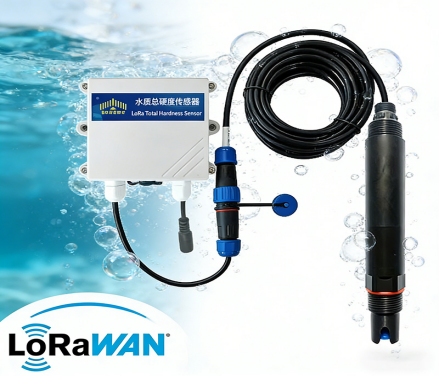
In the Port of Rotterdam, Netherlands, a LoRa water quality sensor network is deployed across the port’s waters, monitoring the impact of industrial discharge on water quality in real time. If hardness or other indicators show anomalies, the system automatically issues early warnings, helping port managers quickly trace pollution sources.
In rural Kenyan communities, international aid organizations have installed solar-powered LoRa water quality monitoring stations. Villagers no longer need to walk half a day to deliver water samples to town testing sites. Community managers can check real-time water hardness data for drinking sources on their phones, ensuring every sip children drink is safe.
In smart aquaculture farms in China, breeders use LoRa sensors to track hardness changes in breeding water in real time. When hardness fluctuations risk affecting fish and shrimp growth, the system automatically activates aeration or water exchange equipment, shifting from “experience-based fish farming” to data-driven fish farming.
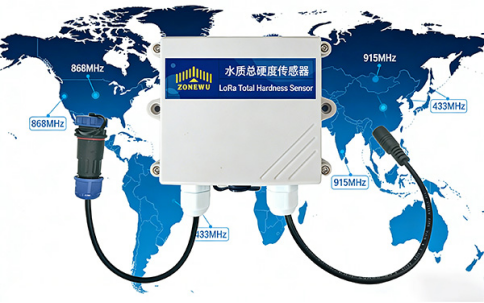
Water hardness is just one of many water quality indicators, but it represents a larger trend: IoT technology is moving water resource management from reactive response to proactive prevention.
LoRa water hardness sensors act like silent guardians, floating quietly in rivers, lakes and water treatment plants. They require no frequent manual maintenance, no expensive infrastructure, yet can issue critical warnings when it matters most, protecting every kilometer from source to tap.
As global water resources grow increasingly scarce, such technology is no longer just an “innovation” — it is becoming a necessity. Because only monitored water is truly protected water.
Contact: Qui
Phone: 18146178586
Tel: 18146178586
Email: qui@zonewu.com
Add: 1501-3, Building F03, Phase III, Software Park, Jimei District, Xiamen City, Fujian Province, China