Welcome: Xiamen ZoneWu Technology Co., LTD.

qui@zonewu.com
18146178586
With the in-depth development of smart water management, LoRaWAN nitrate ion sensors have become critical equipment for drinking water sources, agricultural non-point source pollution, and industrial wastewater monitoring due to their advantages of low power consumption and long-distance transmission. Based on technical parameters and maintenance requirements from typical product manuals, this guide outlines five key dimensions to focus on during procurement, helping you select accurately and avoid common mistakes.
Detection indicators are the top priority when purchasing nitrate sensors. Most mainstream products offer two measuring ranges: 0–100.0 mg/L (default) and 0–1000.0 mg/L, with a resolution of 0.1 mg/L. Typical accuracy is ±5% of reading or ±2 mg/L (whichever is greater), with built-in automatic temperature compensation (accuracy ±0.5℃).
Procurement Tips:Choose the range according to actual nitrate concentration in water bodies: 0–100 mg/L for drinking water sources, and 0–1000 mg/L for industrial or agricultural drainage, to avoid over-range or wasted accuracy.
Special attention must be paid to interfering ions. Nitrate electrodes are susceptible to interference from anions including ClO₄⁻, I⁻, CN⁻, Br⁻, NO₂⁻, and Cl⁻. For instance, 10⁻⁴ M CN⁻ can cause a 10% error at 10⁻³ M nitrate concentration. Therefore, for complex water bodies (e.g., industrial wastewater with high chloride or nitrite), prioritize products with interference compensation algorithms or manual calibration, and require suppliers to provide test data under typical interference conditions.
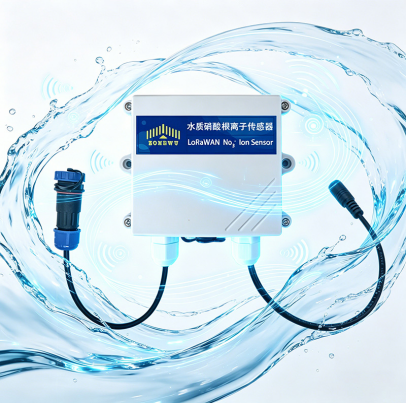
The electrode is the core consumable of the sensor. High-quality electrodes have a service life of 1–2 years, superior to the typical 3–6 months for standard versions. Before use, electrodes generally require 24-hour activation in tap water; when not in use for long periods, they should be stored dry with a protective cap. If the sensitive membrane becomes translucent or deposits form, rinse with distilled water; replace the electrode if calibration repeatedly fails.
Procurement Tips:Inquire about electrode replacement cost and compatibility. Note the interface type (commonly M16 5-pin waterproof connector), with a standard cable length of 5m (customizable) for easy replacement. Also check installation requirements: the sensor must not be installed upside down or horizontally, and must be tilted at least 15° to ensure stable measurement. Evaluate on-site installation conditions during procurement.
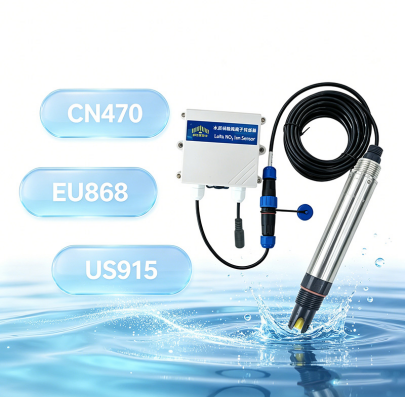
Mainstream products support frequency bands including CN470, EU868, and US915, with OTAA network access and optional Class A/C modes. The default reporting interval is 10 minutes (adjustable from 1–65535 seconds via downlink commands). Power supply is typically DC10–28V, rated at approx. 12V/500mA, with a DC5.5×2.1mm connector (center positive, outer negative). Configuration is done via a TYPE-C port connected to a computer, using dedicated software to modify DevEUI, AppEUI, AppKey, and reporting intervals.
Procurement Tips:Verify gateway compatibility with the sensor’s frequency band and LoRaWAN version (e.g., 1.0.3). For off-grid sites without mains power, evaluate power solutions — if no built-in battery is available, use a solar-battery system. Status indicators (green blinking for joining, steady on for network success) simplify on-site commissioning.
Sensors are factory-calibrated but require recalibration after prolonged use. Premium sensors support two-point calibration: zero calibration (using 10 mg/L or 100 mg/L standard solution, based on range) and slope calibration (using 100 mg/L or 1000 mg/L standard solution). Temperature calibration (against a reference thermometer) is also available. Calibration can be performed via downlink commands (hexadecimal frames) and triggered remotely from the platform.
Procurement Tips:Prioritize sensors supporting remote calibration and command configuration to greatly reduce on-site maintenance labor. Confirm whether the supplier provides standard solutions and sample calibration protocols — technically capable teams can integrate these independently.
Initial Cost: Sensor unit price + power adapter + mounting bracket (request product dimensions and installation drawings in advance for evaluation).
Operation & Maintenance Cost: Electrode replacement every 1–2 years, regular purchase of standard solutions, and possible on-site calibration services.
Potential Risks:Data deviation from ignored interfering ions; sensor malfunction due to undervoltage; unstable readings from trapped air bubbles caused by improper installation angle.
Avoidance Tips:Do not choose based solely on low prices. Request complete user manuals (including technical parameters, interference tables, calibration commands, and maintenance methods), and verify electrode replacement cycles and anti-interference performance. Prefer suppliers offering configuration tools, firmware updates, and responsive after-sales technical support.
In conclusion, when purchasing LoRa nitrate ion sensors, verify item by item the measuring range, accuracy, interference resistance, electrode lifetime, power supply, communication protocol, and calibration methods against the official product manual. A transparent, detailed manual is itself a sign of a reliable supplier. We hope this guide helps you make informed procurement decisions.https://www.zonewu.com/en/Water-quality-sensor.html
Contact: Qui
Phone: 18146178586
Tel: 18146178586
Email: qui@zonewu.com
Add: 1501-3, Building F03, Phase III, Software Park, Jimei District, Xiamen City, Fujian Province, China