Welcome: Xiamen ZoneWu Technology Co., LTD.

qui@zonewu.com
18146178586
In modern industrial safety, environmental monitoring and intelligent building management systems, carbon monoxide (CO) detection is an indispensable critical task. Colorless and odorless, CO can cause severe harm to the human body or even be fatal in a short period of time. Therefore, it is crucial to select a CO sensor with stable communication and precise measurement. With excellent anti-interference capability and long-distance transmission performance, the RS485 gas CO sensor has become one of the preferred solutions in the professional monitoring field.
Compared with conventional sensors with 4-20mA analog output or 0-10V voltage output, RS485 adopts differential signal transmission and features strong common-mode interference immunity. In environments with complex electromagnetic interference such as factory workshops, underground parking lots and tunnels, RS485 ensures stable and error-free transmission of CO concentration data to the control center.
In addition, RS485 supports standard communication protocols such as Modbus RTU, allowing multiple sensors to be connected on the same bus. This greatly reduces wiring costs and construction complexity. The maximum transmission distance of a single bus can reach 1200 meters, easily covering large industrial parks and long-distance pipe corridors.
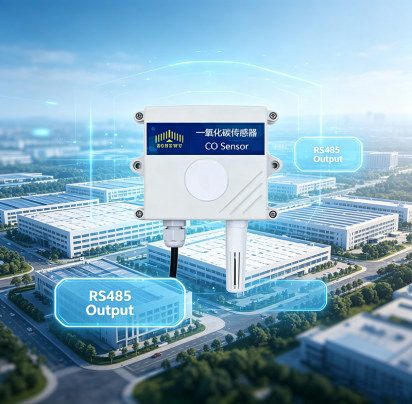
High-quality RS485 gas CO sensors generally adopt the electrochemical detection principle, featuring fast response speed (T90 < 30 seconds), stable zero point and long service life (up to 3-5 years). The common measurement ranges are 0-500ppm and 0-1000ppm with a resolution of up to 1ppm, complying with national safety monitoring standards for industrial sites and public spaces.
The sensor supports 12-24V DC wide voltage power supply, adapting to various on-site power conditions. Built-in automatic zero tracking and temperature compensation algorithms effectively minimize measurement drift caused by changes in ambient temperature and humidity.
Ventilation Linkage in Underground Parking Lots: Automatically activate exhaust fans when the CO concentration exceeds 25ppm, and shut down the fans with a delay once the concentration drops below the threshold, protecting human health while achieving significant energy savings.
Industrial Gas Boiler Rooms: Monitor combustion exhaust leakage to prevent poisoning accidents.
Fresh Air Systems in Smart Buildings: Connect to Building Automation (BA) systems for real-time air quality display.
Coal Mine Safety Monitoring: Realize regional alarm linkage with the ring network system.
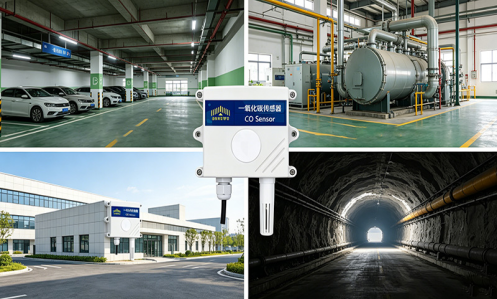
Avoid installing the sensor in direct contact with water, oil stains or organic solvents, and keep it away from cross-interference gases such as sulfur dioxide and hydrogen. Adopt a daisy-chain topology for the RS485 bus instead of star connection, and install matching resistors (typically 120Ω) at both ends of the bus. Set a unique Modbus address for each sensor, and 9600bps is recommended as the stable baud rate.
In conclusion, the RS485 gas CO sensor is an ideal choice for medium and large-scale monitoring systems due to its high reliability, flexible networking and accurate data output. Proper selection and standardized wiring can build a timely responsive and low-maintenance CO safety protection system.
https://www.zonewu.com/en/Environmental-gas-monitoring.html
Contact: Qui
Phone: 18146178586
Tel: 18146178586
Email: qui@zonewu.com
Add: 1501-3, Building F03, Phase III, Software Park, Jimei District, Xiamen City, Fujian Province, China