Welcome: Xiamen ZoneWu Technology Co., LTD.

qui@zonewu.com
18146178586
Ammonia (NH₃) is one of the major hazardous gases in farms, chemical plants, sewage treatment plants and other facilities. Long-term exposure endangers human health and accelerates equipment corrosion. With the advancement of IoT technology, LoRaWAN wireless ammonia sensors have become a mainstream solution for gas monitoring thanks to long transmission distance, low power consumption and wiring-free installation. This guide elaborates core factors for proper product selection.
Detection elements determine sensor performance, with three mainstream types available.
Electrochemical Sensor: Generates electric signals via redox reaction of ammonia on electrode surfaces. It features high sensitivity and fast response, with detection limit down to 0.1 ppm. Widely applied in most scenarios. Service life ranges from 1 to 3 years, and calibration is required every 6 to 12 months.
NDIR Infrared Sensor: Works based on selective absorption of specific infrared wavelengths by ammonia molecules. It delivers superior accuracy and anti-interference capability against temperature and humidity fluctuations. Its service life exceeds 5 years. Higher cost makes it ideal for industrial scenarios demanding strict precision.
Semiconductor Sensor: Detects gas concentration through resistance variation of gas-sensitive materials. It boasts the lowest cost yet suffers mediocre selectivity and stability, suitable for household use and simple linkage monitoring.
Most commercial LoRaWAN ammonia sensors adopt electrochemical detection. Some models offer both electrochemical and semiconductor versions for flexible choices.
Compared with short-range communication protocols like Wi-Fi and ZigBee, LoRaWAN is optimized for low-power wide-area networks. Its sleep current drops to 4.48 μA, supporting over 2 years of battery life. The maximum open-area transmission distance reaches 15 to 20 kilometers. Field applications in farms prove that LoRaWAN sensors enable long-term stable monitoring with infrequent battery replacement, effectively cutting maintenance costs in remote areas.
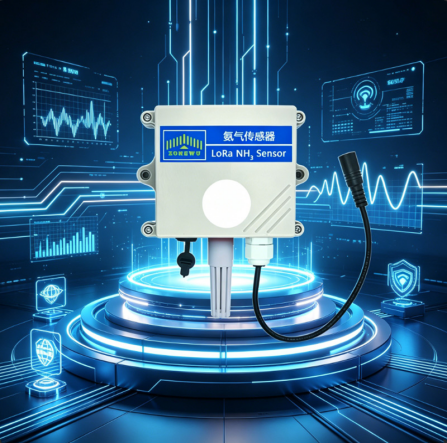
Six critical parameters shall be evaluated during procurement.
Measuring Range: Common ranges include 0-50 ppm, 0-100 ppm and 0-1000 ppm. 0-50 ppm suits indoor farm environments with low safety thresholds. Wide-range models of 0-100 ppm or above are preferred for chemical plants and cold storage to avoid over-range damage.
Accuracy: Standard accuracy is ≤±3% reading or ±5% full scale. High-precision models are mandatory for industrial safety monitoring; moderate accuracy meets demands of trend tracking and basic alarming.
Resolution: Typical specifications are 0.01 ppm and 0.1 ppm. 0.01 ppm resolution fits early warning of low-concentration ammonia in farms, while 0.1 ppm satisfies conventional monitoring needs.
Power Supply & Battery Life: Powered by built-in batteries or external power sources. Built-in batteries last 1 to 5 years depending on data upload frequency. Battery-powered sensors are optimal for off-grid and hard-to-wire sites; external power supports frequent data transmission.
Ingress Protection Level: Marked as IP ratings such as IP30 and IP65. IP30 qualifies dry indoor use. IP65 or higher protection is required for humid and dusty environments like farms and sewage plants to secure stable long-term operation.
Data Upload Interval: Adjustable from 1 minute to 1440 minutes. Short intervals of 1-10 minutes apply to ammonia leakage alarming in cold storage. Intervals longer than 30 minutes are applicable for energy-saving trend recording.
Farms & Greenhouses: Electrochemical sensors with 0-50 ppm range. Integrated temperature and humidity detection and outdoor-grade protection are recommended.
Industrial Safety Sites: NDIR or high-performance electrochemical sensors equipped with local audible and visual alarm. Explosion-proof certification is necessary for hazardous areas.
Public Restrooms & Indoor Odor Monitoring: Compact wall-mounted or ceiling-mounted sensors with built-in buzzer and indicator light. Battery-powered and easy to install without wiring.
Multi-point Network Monitoring: LoRaWAN gateway is required. Standard LoRaWAN protocol devices ensure good compatibility with cloud platforms for large-scale deployment.
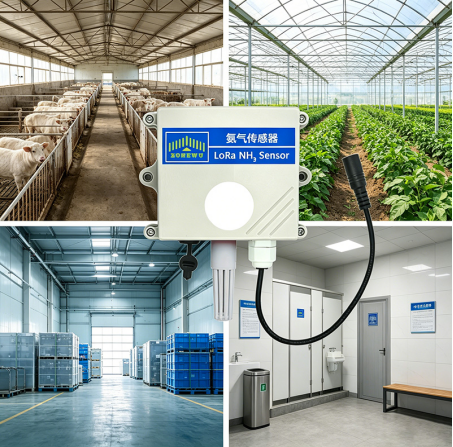
There is no universal best sensor, only the most suitable one. Match detection principles, measuring range, accuracy, power consumption and protection grade with actual site conditions. Confirm monitoring environment, gas concentration level, power access and data update frequency before purchasing, and finalize decisions by comparing product specifications.https://www.zonewu.com/en/-Gas-Sensor_2.html
Contact: Qui
Phone: 18146178586
Tel: 18146178586
Email: qui@zonewu.com
Add: 1501-3, Building F03, Phase III, Software Park, Jimei District, Xiamen City, Fujian Province, China