Welcome: Xiamen ZoneWu Technology Co., LTD.

qui@zonewu.com
18146178586
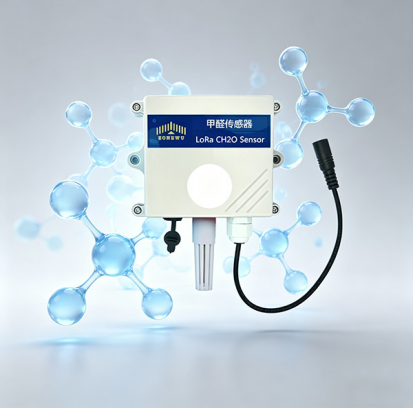
With the maturity of IoT technology, LoRa formaldehyde sensors have become ideal for industrial emission monitoring, chemical plants, large-scale warehouses and other scenarios thanks to their low power consumption and long-distance transmission. Based on the technical characteristics of mainstream electrochemical LoRa formaldehyde sensors, this article summarizes five core purchasing points to help you select accurately and avoid pitfalls.
Formaldehyde sensors on the market mainly fall into three categories: semiconductor, electrochemical and PID. Electrochemical sensors should be prioritized for procurement, as they filter formaldehyde molecules through a specialized membrane, featuring strong anti-interference performance and controllable error. Typical technical specifications: measuring range 0–50 ppm, resolution 0.1 ppm, which meet industrial-grade monitoring requirements.Always confirm the product is marked as "electrochemical" instead of low-cost semiconductor sensors, which are easily interfered by alcohol, perfume and other substances.
Many purchasers easily confuse the units. Common industrial-grade sensors have a measuring range of 0–50 ppm (parts per million by volume), not mg/m³. Conversion ratio: 1 ppm ≈ 1.25 mg/m³ (under normal temperature and pressure). Therefore, such sensors are more suitable for high-concentration leakage early warning or industrial emission monitoring, rather than low-concentration household environments (household standard is approx. 0.08–0.10 mg/m³).Clarify your monitoring scenario before purchase: a 50 ppm range is fully sufficient for chemical plant workshops, while high-sensitivity models with 0–5 ppm range are recommended for offices or newly renovated residences.
High-quality products also provide temperature and humidity compensation, with temperature accuracy up to ±0.3℃ and humidity accuracy ±2%RH, ensuring reliable data.
The typical service life of electrochemical sensors is less than 2 years, which should be included in the budget as consumable cost. The good news is that most products support zero calibration, which is recommended every 6–12 months to extend effective service life. Calibration must be performed in clean air, with the sensor preheated for at least 5 minutes (24-hour aging required for long-unused sensors).
For response speed, pay attention to the data acquisition cycle (default 10 seconds commonly) and reporting cycle (default 5 minutes commonly). When formaldehyde concentration exceeds the set upper and lower thresholds, the device should support immediate continuous reporting 3 times (10-second interval) for rapid alarm.
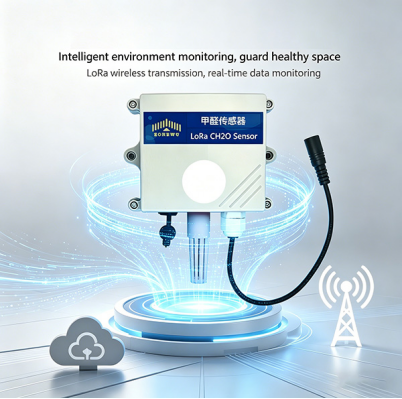
The core advantage of LoRa formaldehyde sensors lies in communication flexibility. Confirm the following points during purchase:
Band support: Whether it covers local LoRaWAN bands (such as CN470/EU868/US915, etc.)
Network access mode: OTAA support for security assurance
Oprating mode: Class C devices can receive downlink commands in real time (remote threshold configuration, calibration, restart), suitable for scenarios requiring frequent interaction; Class A is more power-saving but with downlink delay.
Power interface: Wide voltage support (e.g. 5–28V DC) and TYPE-C configuration interface greatly simplify on-site deployment.
According to the operating environment limits of common products: temperature -20~50℃, humidity 15%~90%RH (non-condensing), and continuous use in 95% high-humidity environment for more than half a month is not recommended. Therefore, such sensors are not suitable for long-term high-humidity environments (e.g. bathrooms, open-air rain-exposed areas), but fully competent for indoor workshops, warehouses, chemical laboratories and other places.
Industrial environments with potential formaldehyde leakage, such as chemical plants, spraying workshops, plywood factories
Intelligent buildings requiring linkage with exhaust systems (supports threshold-triggered reporting)
Large-area warehouses, leveraging LoRa’s strong penetration and wide coverage
Newly renovated household detection (industrial-grade range is too large, with insufficient low-concentration resolution)
Continuous high-humidity environments (e.g. greenhouses, laundry rooms)
Keep these key points in mind when purchasing LoRa formaldehyde sensors:
Confirm it adopts electrochemical principle, with range and resolution matching the actual concentration range
Service life is less than 2 years, and regular replacement budget shall be included
Supports zero calibration, performed every 6–12 months
Select Class C or Class A operating mode according to application requirements
Avoid high-humidity environments with long-term 95%RH
Finally, it is recommended to use the configuration tool provided by the manufacturer to modify DevEUI/AppEUI/AppKey after purchase, and set the frequency mask according to the on-site band. The first reporting will be generated after 3 minutes of preheating upon initial power-on, please wait patiently.https://www.zonewu.com/en/-Gas-Sensor.html
Contact: Qui
Phone: 18146178586
Tel: 18146178586
Email: qui@zonewu.com
Add: 1501-3, Building F03, Phase III, Software Park, Jimei District, Xiamen City, Fujian Province, China