Welcome: Xiamen ZoneWu Technology Co., LTD.

qui@zonewu.com
18146178586
As hydrogen energy is increasingly adopted on a large scale in energy storage, industrial production and new energy sectors, safety risks arising from hydrogen leakage have grown significantly. ZONEWU’s LoRaWAN hydrogen sensor leverages the three-electrode electrochemical detection technology, integrating high-precision data collection, wireless transmission and intelligent alert capabilities. Boasting high sensitivity and excellent stability, it serves as a pivotal device for hydrogen safety monitoring across diverse industries, and is ideally suited to address multi-scenario safety protection requirements.
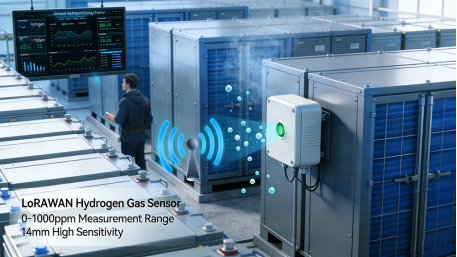
Energy Storage Safety: Fortifying Defenses for Hydrogen Energy and Battery Energy Storage
Scenarios such as lithium battery energy storage stations and hydrogen fuel cell storage systems are prone to hydrogen leakage caused by equipment malfunctions, overcharging, and overheating. Once the concentration exceeds the limit, it may trigger explosion risks. This sensor features a hydrogen measurement range of 0–1000 ppm and a high resolution of 1 ppm, enabling it to accurately detect trace leaks and deliver early warnings. It supports customizable upper and lower hydrogen concentration thresholds (1–65535 ppm); when thresholds are exceeded, it can interface with DO transistor outputs to trigger local alarms or power-off controls, thus eliminating hazards at the source. Integrated with LoRaWAN remote transmission technology, it provides full coverage for large-scale energy storage sites, allowing managers to centrally monitor multi-point data via a dedicated platform without on-site presence, which significantly improves management efficiency. Its wide-voltage power supply design (5–28 VDC) is well-suited to the complex power supply environments of energy storage scenarios, ensuring 24/7 stable operation.
Industrial Production Scenarios: A Safety Barrier Tailored for Harsh Working Conditions
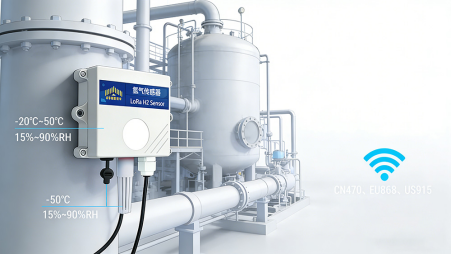
In settings such as chemical plants, hydrogen energy production lines and metallurgical factories, hydrogen—used either as a raw material or by-product—carries leakage risks throughout the entire production, storage and transportation processes. Equipped with a high-performance microprocessor and anti-interference design, this sensor can operate stably in harsh industrial environments with temperatures ranging from -20℃ to 50℃ and humidity of 15%–90% RH (non-condensing), free from electromagnetic interference and cross-sensitivity to other gases. It features a default 5-minute data reporting interval (flexibly adjustable from 1 to 65535 seconds) and will automatically send three consecutive alerts in the event of anomalies, ensuring rapid response by on-site personnel. Supporting global frequency bands including CN470, EU868 and US915, it is ideally suited for the deployment requirements of cross-border industrial projects. There is no need to adjust or replace equipment for different regions, which reduces procurement and maintenance costs.
Confined Space Monitoring: Solving the Challenges of Complex Environment Monitoring
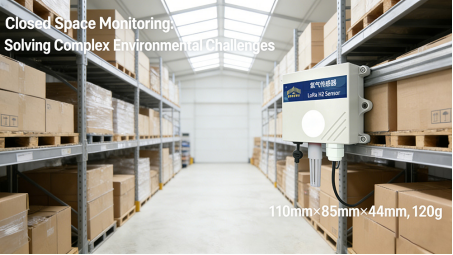
Confined spaces such as underground hydrogen pipelines, tunnels, and sealed warehouses have poor ventilation, which makes hydrogen highly prone to accumulation. Meanwhile, traditional wired sensors are cumbersome to install and maintain. With compact dimensions of just 110mm×85mm×44mm and a weight of 120g, this sensor is small and lightweight, allowing flexible installation in narrow spaces. It adopts a wireless transmission design that eliminates the need for complex wiring, and its low-power consumption supports long-term unattended operation, significantly reducing construction and post-maintenance workloads.
It is equipped with a built-in green LED indicator: blinking signifies that the device is connecting to the network, while a steady light indicates a successful connection, enabling on-site personnel to quickly troubleshoot network faults. Supporting OTAA network access and Class A/C operation modes (Class C as default), the sensor ensures stable signal transmission and accurate data reporting—even in confined environments with weak signal strength.
Routine Environmental Monitoring: Ideal for Safety Management Across Diverse Fields
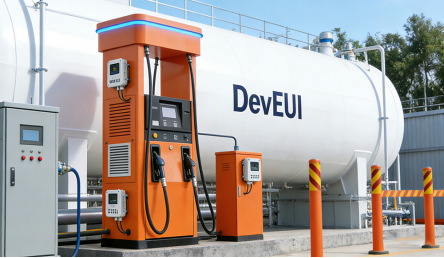
Scenarios requiring continuous hydrogen concentration monitoring, such as research institutions and hydrogen refueling stations, impose extremely high requirements for sensor accuracy and stability. This sensor adopts an electrochemical detection principle, delivering high measurement precision and minimal drift. It allows zero-point calibration via the FE14EF command every 6–12 months, ensuring long-term data reliability.
The integrated Type-C interface serves dual purposes of configuration and power supply. Paired with a dedicated configuration tool for Windows systems, it enables flexible adjustment of parameters such as data collection intervals and reporting cycles, meeting the customized monitoring needs of different scenarios. Pre-configured with parameters including DevEUI and AppEUI at the factory, the device supports custom modifications and can be quickly integrated into existing LoRaWAN networks, ensuring high deployment efficiency.
Equipped with core advantages including high-precision detection, wide-range adaptability, and intelligent early warning, this LoRaWAN hydrogen sensor meets hydrogen safety monitoring requirements across diverse scenarios such as energy storage, industrial production, and confined spaces. Backed by a 1-year warranty and comprehensive technical support, it ensures hassle-free operation and has become a trusted solution for industries to prevent hydrogen leakage risks and safeguard safe production.
Contact: Qui
Phone: 18146178586
Tel: 18146178586
Email: qui@zonewu.com
Add: 1501-3, Building F03, Phase III, Software Park, Jimei District, Xiamen City, Fujian Province, China