Welcome: Xiamen ZoneWu Technology Co., LTD.

qui@zonewu.com
18146178586
In complex scenarios such as industrial workshops and industrial parks, the monitoring of phosphine (PH₃) is crucial—it not only relates to compliant production but also directly affects personnel safety. Faced with a wide range of gas sensors on the market with numerous parameters that are difficult to distinguish between advantages and disadvantages, how should you choose? This article will analyze a highly recommended LoRaWAN PH3 temperature and humidity sensor, and from the perspective of adaptability to real scenarios, tell you why it has become a reliable choice for many people to "buy without hesitation".
1. Scenario Adaptability: Easily Cope with Complex Working Conditions
When choosing a sensor, you shouldn't just look at parameters; the key is whether it can truly integrate into your actual environment—no matter how excellent the performance is, if it doesn't match the environment, it's hard to exert its value.
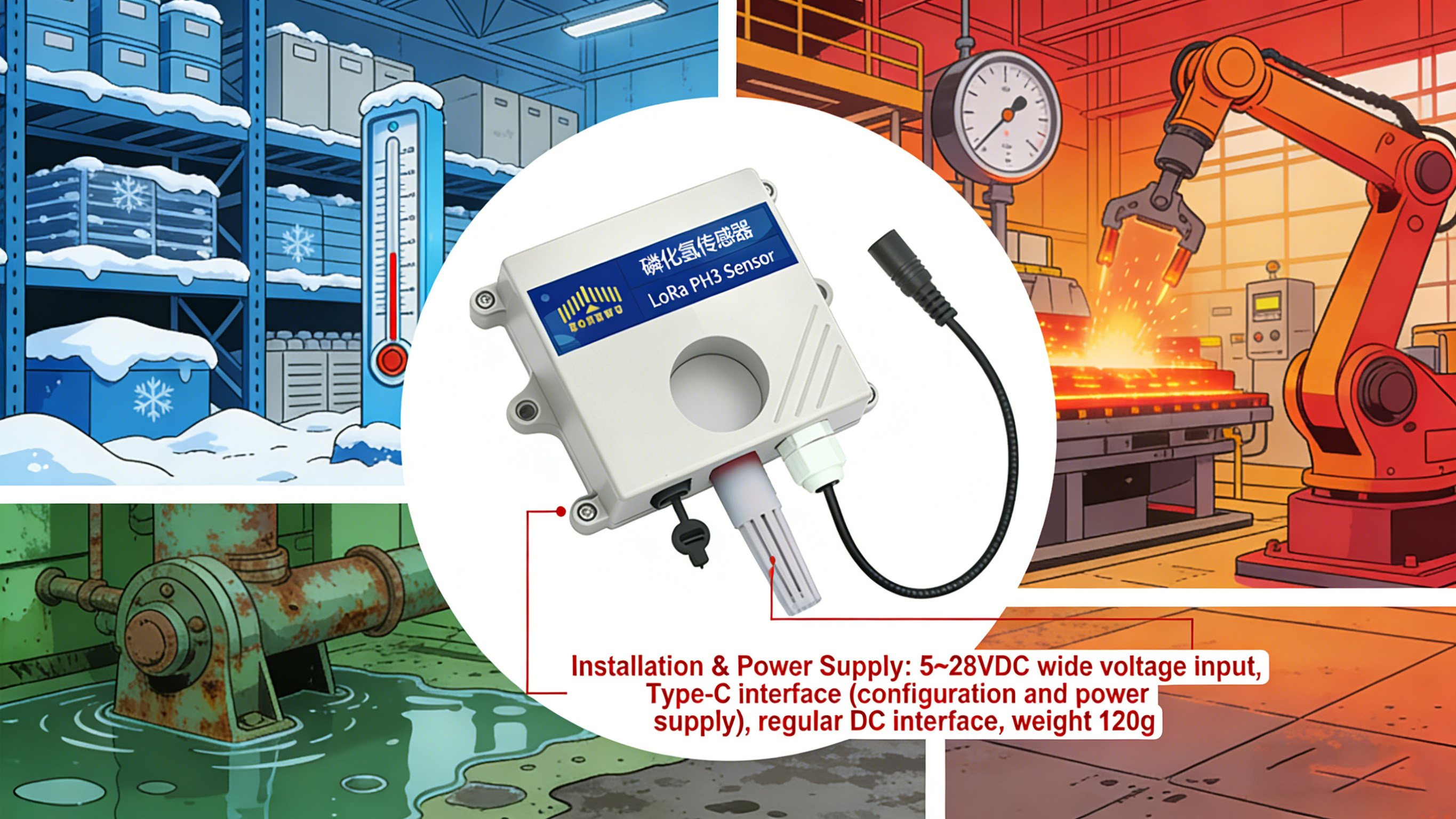
Strong Environmental Compatibility: The sensor can calmly cope with various industrial environments, whether it's low-temperature storage or high-temperature workshops, and can maintain stable operation. It also has good adaptability to humidity and can work normally within a wide humidity range (it can withstand short-term exposure to high-humidity environments, but long-term exposure to extreme humidity conditions is not recommended).
Flexible and Convenient Installation and Power Supply: Supports 5~28VDC wide voltage input, equipped with a Type-C interface (for both configuration and power supply) and a regular DC interface, making both fixed installation and mobile debugging extremely convenient. With an overall weight of only 120g, the lightweight design makes installation and carrying effortless.
2. Accurate Monitoring: Core Performance Builds a Solid Safety Line
For gas sensors, "accurate measurement and fast alarm" are the bottom lines—and this sensor truly delivers!
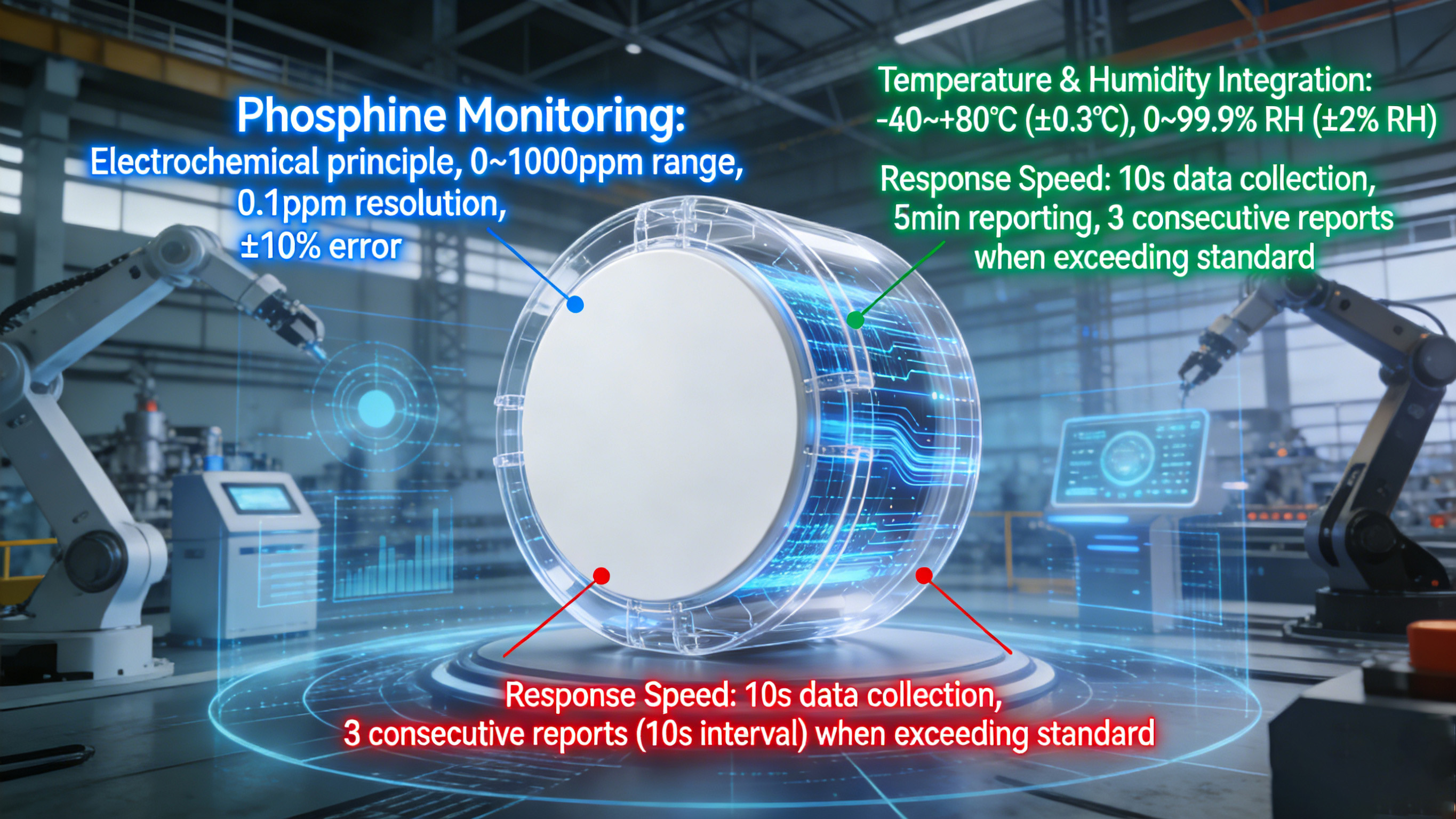
Professional Phosphine Monitoring: Adopts the electrochemical principle, with a measurable concentration range of 0~1000ppm, a resolution as precise as 0.1ppm, and an error of only ±10%—even a small amount of gas leakage can be accurately detected without missing alarms or false alarms.
Integrated Temperature and Humidity Saves Costs: No need to equip additional temperature and humidity sensors. The built-in probe can measure temperatures from -40~+80℃ (accuracy ±0.3℃) and humidity from 0~99.9% RH (accuracy ±2% RH). It accomplishes two things with one investment, directly reducing system integration costs.
Responsive Speed: By default, it collects data once every 10 seconds and reports it once every 5 minutes. If the concentration exceeds the standard, it will actively report continuously 3 times (at 10-second intervals), allowing sufficient time for on-site early warning and background linkage.
3. Wireless Empowerment: LoRaWAN Protocol Solves Deployment Challenges
In industrial scenarios, wiring difficulties and long distances are common problems, and the LoRaWAN technology of this sensor directly addresses these pain points!
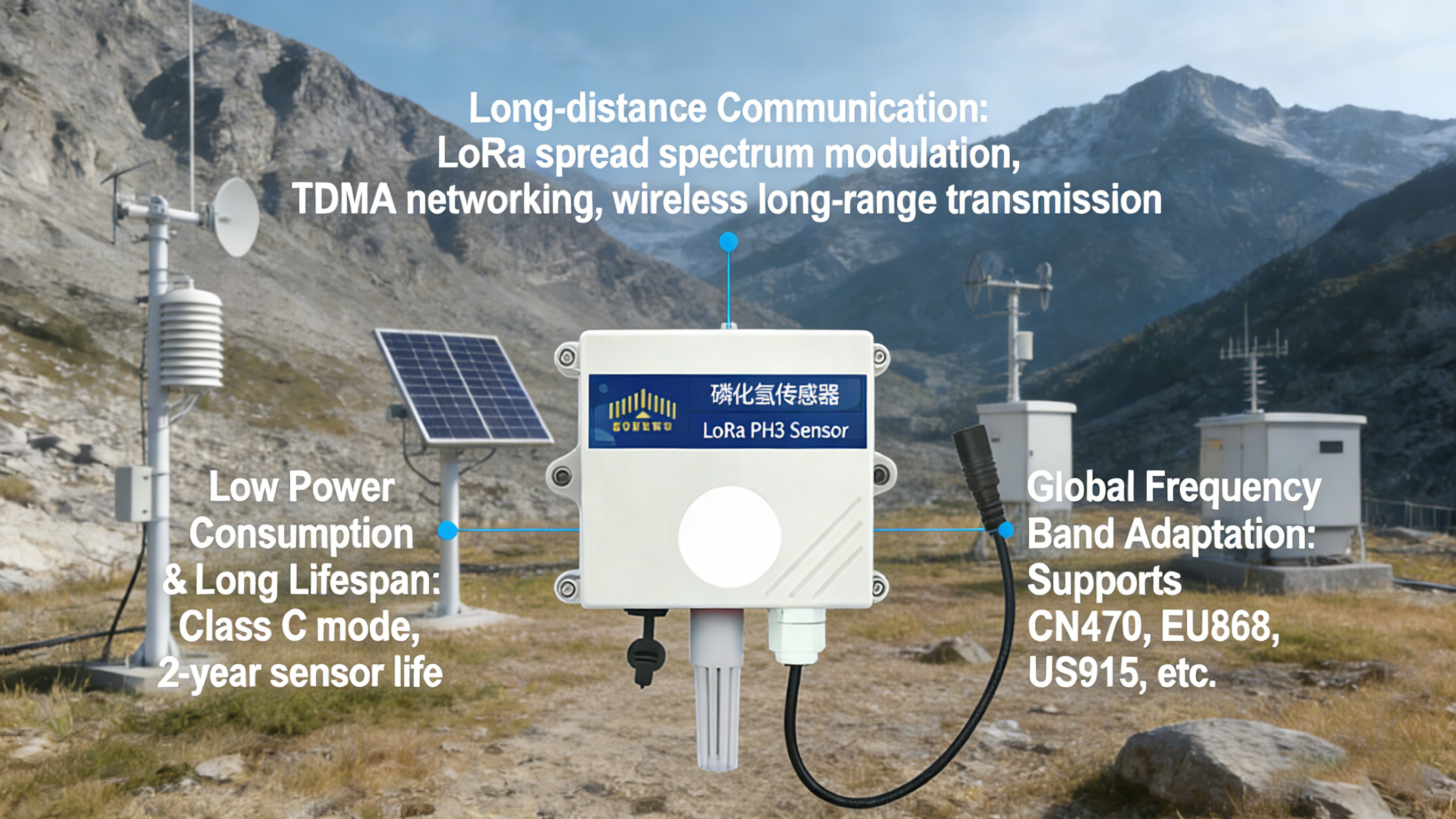
Long-Distance Communication Without Pressure: Uses LoRa spread spectrum modulation technology combined with TDMA networking, enabling ultra-long-distance transmission without pulling wires. It can fully cover large-area industrial parks, eliminating the need for complex wiring projects and reducing costs.
Low Power Consumption + Long Service Life: Works in Class C mode by default, which is extremely energy-efficient. The sensor has a service life of up to 2 years, eliminating the need for frequent device or battery replacements and making maintenance extremely convenient.
Global Frequency Band Compatibility: Supports mainstream global LoRa frequency bands such as CN470, EU868, and US915. Whether used domestically or deployed in cross-border parks, there's no need to replace the device—just configure it and use it, with full versatility.
4. Easy Operation: Worry-Free Whole Process of Configuration, Installation, and Maintenance
As industrial equipment, the last thing you want is "good-looking parameters but troublesome to use"—but the operation experience of this sensor is really user-friendly!
Super Simple Configuration: With a Windows computer, a Type-C data cable, download the configuration tool from the official website, install the CH340 driver, connect the device, and open the COM port (default baud rate 115200bit/s). Follow the steps of "Enter Configuration - Load Parameters - Modify Parameters - Write - Restart"—no professional programming knowledge is required.
Installation Completed in 5 Minutes: Wall-mounted design with dimensions of 110mm×85mm×44mm. Just drill a 5mm hole, insert an expansion tube, and fix it. On-site workers can install it themselves without hiring a professional team.
Status at a Glance: Built-in green LED indicator—blinking means it's connecting to the network, and steady on means successful network access. There's no need to connect to a computer to check logs; you can judge whether the device is working normally on-site.
Reliable Maintenance Support: 1-year warranty period, supporting one-click firmware upgrade. The sensor can also undergo remote zero-point calibration after 6-12 months of use to extend its service life, ensuring worry-free subsequent use.
5. Quick Selection: 3 Steps to Lock in the Adaptable Solution
Check the Scenario: If it's for industrial workshops, parks, or environmental monitoring points that require long-distance, wireless, and simultaneous monitoring of temperature, humidity, and phosphine, directly choose this one.
Verify Parameters: Confirm whether the phosphine measurement range and accuracy meet industry compliance requirements, and whether additional configuration is needed for temperature and humidity monitoring. Its integrated design can basically cover most needs.
Calculate Costs: Compare wiring costs, equipment procurement costs, and maintenance costs. The wireless deployment, low power consumption, and long service life of this sensor result in a really low full-life-cycle cost.
When choosing an industrial gas sensor, there's no need to pursue "maxed-out parameters"—the key is "scenario adaptability and ease of use". This LoRaWAN PH3 temperature and humidity sensor not only has accurate monitoring performance but also the convenience of wireless deployment, while saving costs and reducing maintenance efforts. No wonder it has become the first choice for industrial safety and environmental monitoring scenarios. If you're still unsure whether it's suitable for your working conditions or want to learn more about configuration details, directly download the configuration tool from the official website https://www.zonewu.com/en/-Gas-Sensor.html or consult the technical team—professionals will help you with customized solutions! Industrial safety is no trivial matter; choosing the right sensor is the key to truly building a solid line of defense for gas monitoring.
Contact: Qui
Phone: 18146178586
Tel: 18146178586
Email: qui@zonewu.com
Add: 1501-3, Building F03, Phase III, Software Park, Jimei District, Xiamen City, Fujian Province, China