Welcome: Xiamen ZoneWu Technology Co., LTD.

qui@zonewu.com
18146178586
ETO (Ethylene Oxide) sensors based on the LoRaWAN protocol have been large-scale applied in industrial safety, medical sterilization and other fields. Featuring long transmission distance, low power consumption and high precision, they address numerous pain points in traditional ETO monitoring. As a core product integrating gas sensing and IoT technologies, their working principle involves multiple aspects including sensing detection, wireless transmission and data encryption. This type of sensor provides reliable technical support for the monitoring of high-risk gases.
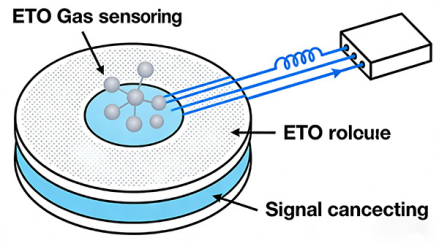
The Core Detection Unit of LoRaWAN ETO Sensors adopts the electrochemical detection principle. It is specially designed for ETO/VOC gas monitoring and integrated with high-performance sensing components and a microprocessor. When ETO gas is present in the measured environment, the sensor captures gas molecules via electrochemical reactions and converts them into identifiable electrical signals. The sensor then calculates the intensity of the electrical signals and converts it into the corresponding ETO concentration value. This sensor has a cross-interference characteristic and exhibits varying degrees of response to gases such as formaldehyde and alcohol, so users need to take scenario-specific measures to avoid such interference. In addition, the sensor is integrated with a temperature and humidity probe that enables synchronous monitoring of ambient temperature and humidity. Within a wide temperature range of -20℃ to 60℃, its detection accuracy can be maintained within ±3%FS, and it is also capable of detecting trace ETO leaks as low as 0.1 ppm.
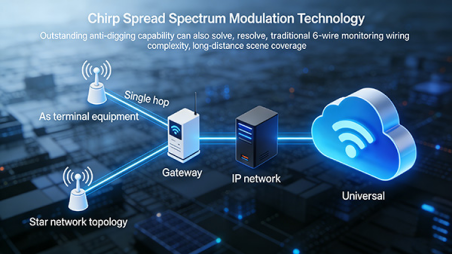
The sensor adopts LoRa spread spectrum technology and LoRaWAN protocol to build a communication link. This solves the problems of cumbersome wiring and insufficient coverage in remote scenarios of traditional wired monitoring. Its transmission principle is based on a star network topology. As an end device, the sensor establishes communication with the gateway through a single-hop method. The gateway then forwards the data to the cloud server through the IP network. During transmission, chirp spread spectrum modulation technology is adopted. This technology spreads narrowband signals to wide frequency bands for transmission, with extremely strong anti-interference capability. It can communicate stably even in complex industrial electromagnetic environments.
Benefiting from the Adaptive Data Rate (ADR) mechanism, the sensor can dynamically adjust the transmission rate and transmit power. Its default working mode is Class C, and it can also be switched to Class A mode. The default data collection cycle is 10 seconds, and the default reporting cycle is 5 minutes (300 seconds). It needs to warm up for 3 minutes after power-on before starting reporting. The device supports multi-band adaptation, covering regional frequency bands such as CN470, EU868 and US915. The sensor weighs only 120g and has a power supply voltage range of 5~28VDC, suitable for long-term unattended monitoring scenarios.
Considering the security and seriousness of ETO monitoring data, the sensor adopts an exclusive key encryption mechanism. It completes identity authentication through three major parameters: DevEUI, AppEUI and AppKey. DevEUI is a 64-bit unique device identifier, AppEUI is a 64-bit application identifier, and AppKey is a 128-bit application key. This prevents data from being tampered with or stolen. Data transmission adopts the Confirmed mode, that is, ACK response is enabled. After sending data, the sensor waits for the server's response to ensure no data loss. Data is transmitted in hexadecimal format, with high bytes first and low bytes later.
The sensor has a built-in microcontroller that preprocesses the collected gas concentration data. After eliminating abnormal data, it encapsulates them into standard data frames. The data includes ETO concentration, temperature and humidity information, which is transmitted through a specified port. The cloud server quickly parses the data after receiving it. If the received data is FFFF FFFF, it indicates that the sensor is disconnected or abnormal. When the concentration exceeds the preset threshold, the device will immediately report data three times at intervals of 10 seconds. When the concentration returns to normal, it will also report three times to trigger an alarm or recovery notification.
The device uses Over-the-Air Activation (OTAA) to access the network. It automatically initiates a network access request after power-on. A blinking green indicator light indicates that it is accessing the network, and a steady green light indicates successful network access. No complex on-site configuration is required. Connect to a computer through a TYPE-C interface and use a dedicated configuration tool to modify parameters. Parameters such as reporting cycle, gas threshold and collection cycle can be set. The sensor supports zero calibration and needs to be calibrated after 6~12 months of use. The device will actively send a calibration result notification after calibration. It adopts wall-mounted installation, which can be fixed with a 5mm diameter drill hole, making deployment convenient.
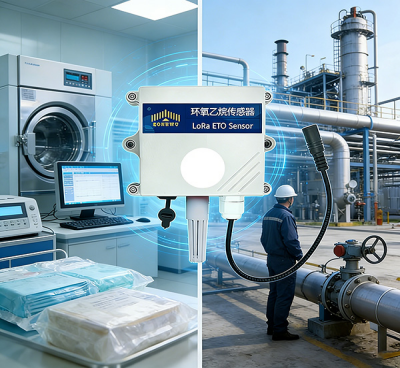
At present, such sensors have been widely used in multiple scenarios, including medical sterilization residue monitoring and ETO pipeline inspection in chemical parks. Through technological innovation, it has realized the intelligent upgrading of gas monitoring and built a solid line of defense for safe production. Industry insiders said that with the improvement of LoRaWAN network coverage, ETO sensors will play a role in more subdivided fields.https://www.zonewu.com/en/-Gas-Sensor.html
Contact: Qui
Phone: 18146178586
Tel: 18146178586
Email: qui@zonewu.com
Add: 1501-3, Building F03, Phase III, Software Park, Jimei District, Xiamen City, Fujian Province, China