Welcome: Xiamen ZoneWu Technology Co., LTD.

qui@zonewu.com
18146178586
With the growing demand for remote water quality monitoring, LoRa solar-powered water quality pH sensors have become an ideal solution for outdoor and off-grid monitoring, thanks to the combination of low-power wide-area network (LPWAN) and renewable energy technologies. This article focuses on the key technical specifications of the product to provide practical guidance for procurement decisions.
The pH sensor is the "heart" of the entire device, and its performance directly determines data quality. Key points for selection:
Electrode Material and Structure
Adopting the glass electrode method, it is suitable for non-corrosive weak acid and weak alkali water environments. As a mature solution for industrial-grade water quality pH detection, it adapts to common monitoring scenarios such as wastewater and aquaculture water.
Measurement Accuracy and Range
Industrial-grade accuracy of ±0.1 pH, full measuring range of 0–14.00 pH, and resolution of 0.01 pH, meeting the detection requirements of mainstream scenarios including industrial wastewater, agriculture, and aquaculture.
Automatic Temperature Compensationp
H values vary with temperature. Equipped with a built-in Pt1000 temperature sensor, it supports free switching between automatic and manual temperature compensation, ensuring reliable and accurate data at different water temperatures.
Electrode Service Life
The electrode has a service life of 6–12 months under normal use. The device is professionally calibrated before delivery; recalibration is unnecessary unless the error exceeds the limit, allowing immediate deployment after procurement.
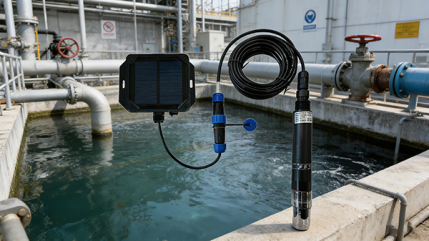
Solar power supply determines whether the device can run maintenance-free after installation. Key points to evaluate:
Battery Capacity
Equipped with a 3.7V/3400 mAh lithium battery paired with a solar panel for recharging. The overall battery life is ≥3 years under normal use, supporting long-term maintenance-free operation outdoors.
Solar Panel Power
Integrated with a 0.88W solar panel, designed specifically for off-grid outdoor scenarios to achieve self-charging and endurance, adapting to various field water quality monitoring installations.
Power Consumption Parameters
The device adopts a low-power design. Due to the power consumption characteristics of the pH sensor, short data reporting intervals are not recommended. The default 30-minute reporting interval is the optimal power-saving scheme to effectively extend battery life.
LoRa communication is critical for device networking, and compatibility with existing systems must be ensured:
Frequency Band Matching
Verify that the sensor supports LoRa frequency bands compliant with local regulations (multiple options available: CN470, EU868, US915, AU915, etc.) to avoid networking failures.
Protocol Standards
Prioritize devices supporting the standard LoRaWAN 1.0.3 protocol + LoRa TDMA ad-hoc networking, with OTAA Class A/C mode. They are compatible with mainstream IoT platforms for reliable interoperability.
Configuration Convenience
Supports connection to a computer via a TYPE-C interface. Parameter settings (sampling interval, frequency band, alarm thresholds, etc.) can be completed via dedicated configuration software, with clear steps for easy on-site commissioning.
Data Decoder
The supplier shall provide a complete hexadecimal Payload Decoder. Both uplink and downlink data use hexadecimal format, which can accurately convert raw data into readable pH value, temperature, battery voltage and other information for easy integration into user platforms.

Outdoor devices must withstand sun, rain, and water immersion:
Protection Grade
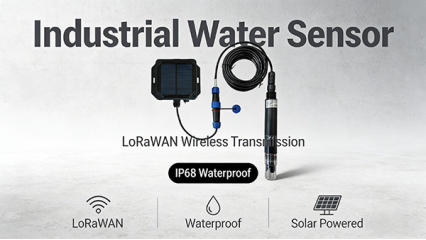
The sensor probe shall reach IP68 (for long-term immersion), and the main unit enclosure at least IP66, ensuring waterproof and dustproof performance.
Installation Method
Check whether a complete installation kit is provided (pole mount bracket, stainless steel protection box, waterproof connector). Whether the probe supports immersion, pipeline, or float-type installation to adapt to different sites.
Anti-Fouling Design
For water with high biological activity (e.g., aquaculture), optional ultrasonic self-cleaning or mechanical brush is available to prevent biofouling from affecting measurement accuracy.
Cloud Platform Compatibility
Can sensor data be directly connected to the user’s existing cloud platform? Does the supplier provide free or paid cloud services with real-time curves, historical query, report export and other functions?
Alarm Function
Supports custom pH upper/lower limit alarms, with notifications via SMS, email, App push, etc.
Multi-Parameter Expansion
Considering future demands, check whether the same platform supports access to other sensors such as dissolved oxygen, turbidity, and conductivity to realize multi-parameter water quality monitoring.
Certifications and Standards
Confirm that the product has international certifications such as CE, RoHS, and the electrode has a CMC or NIST calibration certificate.
Warranty and Support
The whole machine is generally warranted for 1–2 years; the sensor, as a consumable, has a shorter warranty period, which shall be clarified. Does the supplier provide Chinese/English technical documents, API interfaces, and rapid-response support?
Sample Testing
It is recommended to purchase samples for on-site testing before bulk procurement, verifying whether accuracy, battery life, communication and other indicators meet the claimed specifications.
Selecting a LoRa solar-powered water quality pH sensor is a comprehensive decision involving technology, commerce, and application scenarios. Move beyond simple price comparison, and conduct a thorough evaluation from the perspectives of long-term stable operation, data reliability, and supplier support capabilities to select the most suitable product for the project.https://www.zonewu.com/en/Water-quality-sensor.html
Contact: Qui
Phone: 18146178586
Tel: 18146178586
Email: qui@zonewu.com
Add: 1501-3, Building F03, Phase III, Software Park, Jimei District, Xiamen City, Fujian Province, China