Welcome: Xiamen ZoneWu Technology Co., LTD.

qui@zonewu.com
18146178586
Water quality monitoring has always been a top priority in environmental monitoring and smart agriculture. As one of the core indicators of water health, EC (Electrical Conductivity) directly reflects the concentration of soluble salts in water. However, traditional EC monitoring is plagued by three major pain points: difficult power supply, high wiring costs, and data silos.
Today, with the integration of IoT and new energy technologies, LoRa solar-powered water quality EC sensors have emerged. They not only solve the "last-mile" communication challenge but also realize truly unattended operation through photovoltaic technology. Today, we will conduct an in-depth analysis of this cutting-edge product.
For agricultural planting, an excessively high EC value indicates surplus fertilizer, which may cause root burn; an excessively low EC value means insufficient nutrients. For environmental monitoring, abnormal fluctuations in EC values often indicate water pollution.
Traditional monitoring methods usually rely on mains power and require complex RS485 or network cable laying. In vast farmlands, remote rivers or reservoirs, power cable installation is not only costly but also poses safety risks. Meanwhile, traditional wireless solutions are ineffective in areas without 4G coverage.
The biggest advantage of this new sensor is its "low power consumption + wide coverage" design:
LoRa is a LPWAN (Low-Power Wide-Area Network) communication technology. Compared with traditional 4G or Wi-Fi, LoRa has strong penetration, with a communication range of 3–8 km in open areas. Most importantly, its power consumption is extremely low, allowing the whole system to run year-round with just a small solar panel.
Equipped with a high-efficiency monocrystalline silicon solar panel and a built-in low-temperature resistant lithium iron phosphate battery, the device works reliably even during consecutive rainy days. Once installed, it can achieve uninterrupted power supply as long as there is basic sunlight.
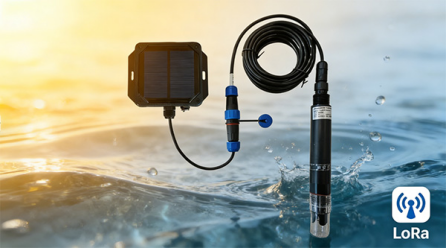
The high independence of this sensor greatly expands the scope of water quality monitoring:
In rice fields, fish ponds and breeding bases, farmers no longer need to take water samples manually with a conductivity meter every day. The device automatically collects data hourly and transmits it to the cloud platform via a LoRa gateway. Once the EC value is abnormal (e.g., excessive salinity or water pollution), an instant alert is sent to the mobile phone.
Municipal environmental protection departments can deploy the sensors in a grid pattern in urban landscape rivers and upstream inlets of drinking water sources. No mains power connection is needed, installation costs are extremely low, forming an invisible "water quality monitoring network".
24/7 uninterrupted monitoring of key sewage outlets with direct data upload, eliminating the risk of manual data tampering or power cuts to evade supervision.
After the collected EC data is aggregated to the cloud via a 4G gateway, the system conducts big data analysis combined with temperature, pH and other parameters. For example, in soilless cultivation, the system can automatically identify the peak fertilizer absorption period of crops based on the daily EC curve, guiding intelligent water-fertilizer machines for precise fertilization and achieving over 30% water and fertilizer savings.
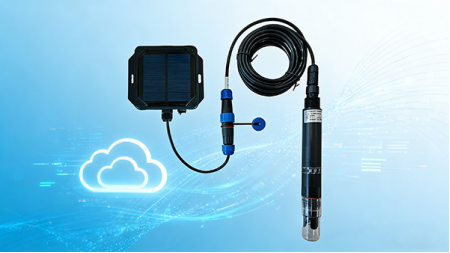
The emergence of LoRa solar-powered water quality EC sensors is not just replacing a power cord with a solar panel—it revolutionizes the monitoring logic. It turns water quality monitoring from "occasional sampling" to "real-time online", and from "manned" to "unattended".
With the arrival of the Internet of Everything era, such low-power, self-powered monitoring terminals will become the most fundamental and critical component for building digital water conservancy and smart agriculture.
If you are struggling with wiring and power supply for field water quality monitoring, perhaps this small solar panel is all you need.
Contact: Qui
Phone: 18146178586
Tel: 18146178586
Email: qui@zonewu.com
Add: 1501-3, Building F03, Phase III, Software Park, Jimei District, Xiamen City, Fujian Province, China