Welcome: Xiamen ZoneWu Technology Co., LTD.

qui@zonewu.com
18146178586
Turbidity, a core indicator for measuring water clarity and pollution levels, directly reflects the concentration of suspended particulates in water. From drinking water purification to industrial wastewater treatment, selecting a suitable turbidity sensor is crucial for safeguarding water quality safety, optimizing treatment processes, and meeting compliance standards. Faced with a wide range of products with varying parameters on the market, a systematic selection approach based on specific application scenarios is essential to achieve precise demand matching.
Clarify Application Scenarios and Lock in Core Performance Requirements
Performance priorities for turbidity sensors vary significantly across different scenarios, and the core demands of the intended application must first be defined:
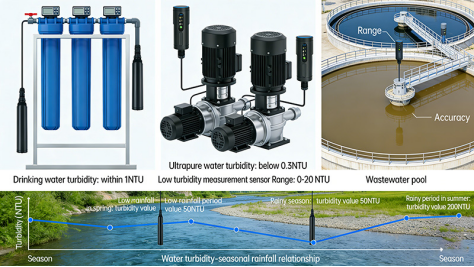
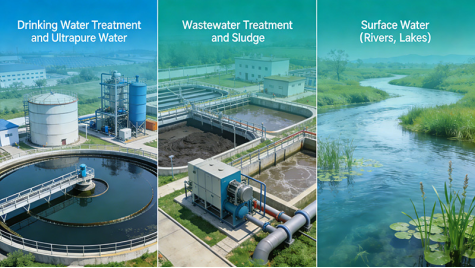
1.Drinking water treatment and ultrapure water systems: Prioritize high measurement accuracy for low turbidity. Select sensors with an adaptive range (0-20 NTU) and a resolution of 0.01 NTU to accurately capture micro-particulates that may carry pathogens. In line with industry standards, the turbidity of drinking water must be controlled within 1 NTU, and that of ultrapure water and water for artificial fiber manufacturing must be below 0.3 NTU to ensure the compliance of effluent quality.
2.Wastewater treatment and sludge concentration monitoring: The equipment must adapt to medium-to-high turbidity environments with significant water quality fluctuations. Multi-range sensors (optional 0-20 NTU/0-200 NTU/0-1000 NTU) are recommended, with corresponding accuracies of ±3% or ±0.3 NTU, ±3% or ±2 NTU, and ±5% or ±3 NTU respectively, to withstand measurement requirements under complex water quality conditions. The turbidity of natural river water typically ranges from tens to hundreds of NTU, and such multi-range devices are also applicable here.
3.Surface water (river and lake) monitoring: Balance the measurement accuracy for medium-to-low turbidity with environmental adaptability, and strike a proper balance between measurement range and sensitivity to cope with turbidity fluctuations in natural water bodies caused by seasonal changes and rainfall.
Optimize the Measurement Principle to Match Turbidity Range Characteristics
The measurement principle is the technical core of sensor selection, and a suitable solution should be chosen based on the target turbidity range:
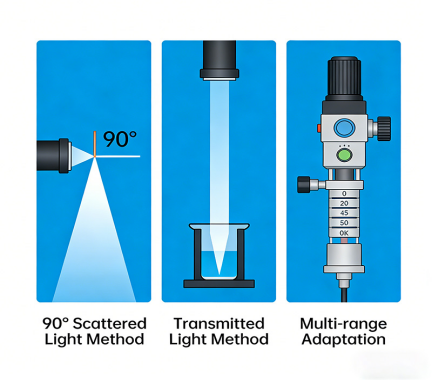
1.90° Scattered Light Method: A mature and commonly used measurement principle, which is adopted by water quality turbidity sensors. Equipped with an infrared LED light source, an optical fiber transmission light path and a built-in filtering algorithm, it features strong resistance to external light interference.This principle is suitable for low to medium turbidity scenarios (drinking water, surface water). Combined with the automatic temperature compensation (Pt1000) function, it can operate stably within a temperature range of 0–40℃, and achieves both high measurement sensitivity and accuracy.
2.Transmitted light method: Suitable for high-turbidity environments (industrial wastewater and sludge tanks). Dense particulates in high-turbidity water tend to block scattered light, while the attenuation degree of transmitted light can accurately reflect turbidity, delivering better measurement stability.
3.Multi-range adaptive solution: Compared with a single principle, scattered light sensors supporting multi-range switching (e.g., three ranges of 0-20/200/1000 NTU) are more adaptable to complex scenarios with large turbidity fluctuations (e.g., various process sections of municipal sewage treatment plants and surface water monitoring in flood seasons). Through precise algorithm optimization, the sensors can ensure measurement accuracy across different turbidity intervals without the need for frequent equipment replacement.
https://www.zonewu.com/en/Water-quality-sensor_1.html
Contact: Qui
Phone: 18146178586
Tel: 18146178586
Email: qui@zonewu.com
Add: 1501-3, Building F03, Phase III, Software Park, Jimei District, Xiamen City, Fujian Province, China