Welcome: Xiamen ZoneWu Technology Co., LTD.

qui@zonewu.com
18146178586
Chloride ions are anions widely present in water bodies, and their content directly affects water safety and the normal operation of equipment. Excessive chloride ions are likely to cause equipment corrosion, ecosystem damage and human health impairment. Under different application scenarios, there are significant differences in water composition, chloride ion concentration range and service environment, so chloride ion sensors shall be selected in a targeted manner.
1. Industrial Circulating Water Scenario
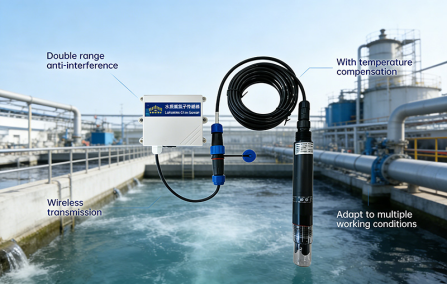
As a core scenario for chloride ion monitoring, the circulating water in industries such as electric power and chemical engineering has a high concentration multiple, and the chloride ion concentration needs to cover the conventional range of 0~3500mg/L and the wide range of 0~35000mg/L. Since the water body contains corrosion inhibitors, scale inhibitors and interfering ions such as S²⁻ and I⁻, the LW115D ion selective electrode sensor is the preferred choice. This sensor is equipped with a Pt1000 automatic temperature compensation module, resistant to interference from organic substances and turbidity, with a measurement accuracy of ±5% of the reading. It can adapt to the working conditions of 0~50℃, ≤0.2MPa and pH2~12, and supports LoRaWAN wireless transmission (reporting every 10 minutes by default, adjustable). The electrode service life is about 1 year, and it can be linked with the control system for automatic regulation to reduce operation and maintenance costs.
2. Municipal Water Supply and Drinking Water Treatment Scenario
The requirements for monitoring accuracy are stringent, and the chloride ion content shall comply with GB 5749-2022 Standards for Drinking Water Quality with a limit value of ≤250mg/L. The water composition is simple, but interference from S²⁻ and I⁻ shall be avoided. The chloride ion sensor can meet the requirements, with full coverage of the 0~3500mg/L range and a resolution of 0.1mg/L, suitable for accurate detection of low concentrations. The sensor is calibrated ex-factory and supports LoRaWAN remote transmission; zero and slope calibration are only required when the error exceeds the standard. The installation shall maintain an inclination angle of ≥15°, adopt waterproof connectors, and the parts in contact with water bodies shall be anti-corrosion and waterproof to eliminate secondary pollution.

3. Aquaculture Scenario
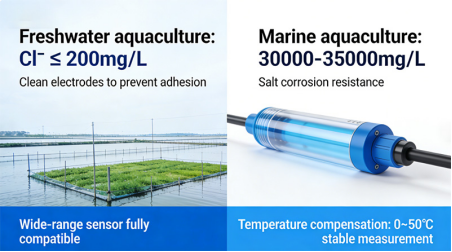
The chloride ion content for freshwater aquaculture shall be ≤200mg/L, and mariculture needs to adapt to the high-concentration environment of 30000-35000mg/L; this wide-range sensor can be fully adapted to such conditions. The water body in freshwater aquaculture has high turbidity, so the sensitive membrane of the electrode shall be cleaned regularly to prevent biological adhesion and avoid interfering ions; mariculture needs to focus on salt corrosion resistance, and the sensor has a built-in temperature compensation function to ensure stable measurement under water temperature fluctuations of 0~50℃. It can be wall-mounted outdoors (drill hole diameter of 5mm), and the multi-band LoRaWAN is adapted to signals in different regions. The data is linked with the control system to issue automatic early warnings in case of abnormal concentrations. When the electrode is idle, it shall be soaked in a special solution for activation and storage.
4. Environmental Monitoring Scenario
The chloride ion concentration has a large span, and the 0~35000mg/L wide range of the LW115D can fully cover all concentration ranges, adapting to the complex working conditions of pH2~12, 0~50℃ and ≤0.2MPa, and resisting interference from heavy metals, suspended solids and S²⁻. Monitoring at industrial wastewater discharge outlets supports data upload in hex format, facilitating traceability and compliance control; it can be deployed portably and quickly in emergency scenarios, with parameters configured through the Type-C interface. When the error exceeds the standard, zero, slope and temperature calibration shall be conducted (calibration values are issued in hexadecimal); electrode faults shall be replaced in a timely manner to ensure measurement accuracy.
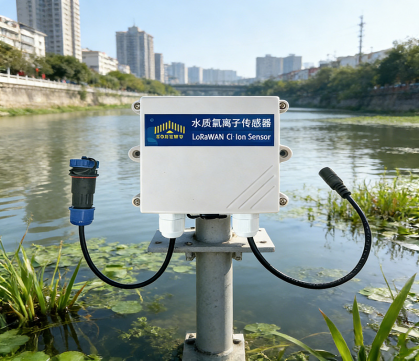
In summary, the selection of chloride ion sensors shall focus on four core aspects: range adaptability, anti-interference capability, communication compatibility and installation adaptability. Each scenario has different key points: industrial scenarios focus on wide range and wireless transmission stability; water supply scenarios emphasize measurement accuracy and installation specifications; aquaculture scenarios pay attention to anti-pollution performance and temperature adaptability; environmental monitoring scenarios focus on anti-interference capability and calibration convenience. Through standardized installation, regular maintenance and calibration, the performance of water quality chloride ion sensors can be fully exerted, realizing accurate control of chloride ions in all scenarios and meeting the needs of water quality monitoring.https://www.zonewu.com/en/Water-quality-sensor.html
Contact: Qui
Phone: 18146178586
Tel: 18146178586
Email: qui@zonewu.com
Add: 1501-3, Building F03, Phase III, Software Park, Jimei District, Xiamen City, Fujian Province, China