Welcome: Xiamen ZoneWu Technology Co., LTD.

qui@zonewu.com
18146178586
1.Core value of IoT integration
In the trend of digital and intelligent transformation of water environment monitoring, the in-depth integration of chlorophyll sensors and IoT systems has become the key to solving the pain points of traditional monitoring. Relying on LoRaWAN wireless communication technology, the new generation of water quality chlorophyll sensors, with the support of standardized protocols, high-precision data transmission and flexible adaptation capabilities, realize seamless connection with IoT systems, providing real-time and efficient intelligent monitoring solutions for scenarios such as water ecological protection and water quality management and control.
2. Core Detection Technology and Performance Parameters
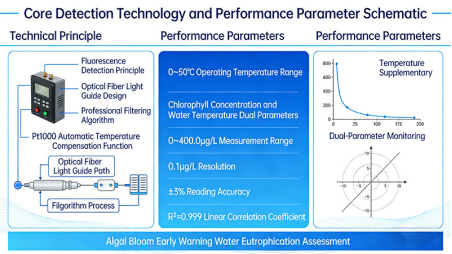
It adopts the fluorescence detection principle and optical fiber light-guiding design, with a built-in professional filtering algorithm, which can effectively resist external light interference and ensure the stability of measurement data.
Equipped with the Pt1000 automatic temperature compensation function, it can accurately capture the dual parameters of chlorophyll concentration and water temperature within the wide operating temperature range of 0–50℃.
The measurement range covers 0–400.0μg/L, with a resolution of 0.1μg/L, reading accuracy of ±3%, and linear correlation coefficient R² as high as 0.999, providing reliable data support for algae bloom early warning and water eutrophication assessment.
3. IoT Integration and Networking Capability
It natively supports the standard LoRaWAN protocol and LoRa TDMA networking technology, is compatible with multi-regional frequency bands worldwide, and adopts the OTAA Class A/C operating mode, enabling quick access to various IoT cloud platforms.
Equipped with a globally unique identification code, combined with user-customizable security keys, it ensures secure and stable network registration and data transmission.
Automatic networking and connection are completed upon activation, with indicator lights providing real-time feedback on network status. Once networking is successful, the device immediately enters the data reporting mode, eliminating the need for complex manual intervention throughout the process.
4. Data Interaction and Remote Management Capability
The default data reporting interval is 10 minutes, with flexible customization available in the range of 1–65535 seconds. The transmission frequency can be dynamically optimized according to the accuracy requirements of different monitoring scenarios.
It adopts a standardized hexadecimal data format, allowing chlorophyll concentration and temperature data to be rapidly parsed, stored, and analyzed by IoT platforms. When the sensor malfunctions, a specific identifier will be transmitted to facilitate timely troubleshooting.
It supports downlink command interaction. Users can remotely perform operations such as device restart, reporting interval adjustment, zero calibration, slope calibration, and temperature calibration via the IoT platform, achieving full-lifecycle remote management of devices and significantly reducing operation and maintenance costs.
5. Installation Adaptability and Environmental Durability
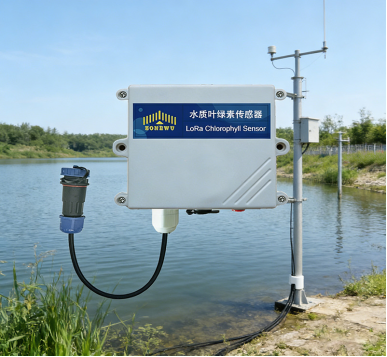
Multiple installation methods are available, including top flange mounting, side wall mounting, underwater installation, and pipeline installation. Maintaining an inclination angle of over 15° during installation ensures measurement stability, catering to the deployment requirements of different water environments.
Featuring a wide-voltage power supply design (DC10~28V), it comes with standard cables and supports customized cable lengths. The electrode has a service life of 6–12 months and can operate stably under a pressure of <0.2MPa.
It can run reliably for long periods in natural water bodies such as lakes and reservoirs, as well as artificial scenarios including drinking water sources and aquaculture ponds.
6. Application Scenarios and Industry Value
It has been widely applied in fields such as ecological environment monitoring, drinking water source protection, and intelligent aquaculture management.
Through in-depth integration with IoT systems, it builds a full-link closed-loop system covering data collection – real-time transmission – cloud-based analysis – anomaly early warning – remote management and control, which completely overcomes the lag and limitations of traditional manual sampling and monitoring.
Users can view data reports in real time via terminals such as computers and mobile phones, complete trend prediction by combining platform algorithms, and avoid environmental risks such as water blooms in advance.
Industry experts stated that this integrated application drives the upgrading of water quality monitoring technology, helps water environment governance enter a new stage of precision, intelligence, and high efficiency, and provides solid technical support for the sustainable utilization of water resources.https://www.zonewu.com/en/Water-quality-sensor.html
Contact: Qui
Phone: 18146178586
Tel: 18146178586
Email: qui@zonewu.com
Add: 1501-3, Building F03, Phase III, Software Park, Jimei District, Xiamen City, Fujian Province, China