Welcome: Xiamen ZoneWu Technology Co., LTD.

qui@zonewu.com
18146178586
Time to Replace the "Old Solutions" for Water Quality Monitoring Pain Points
In many water quality management scenarios, the drawbacks of traditional monitoring methods have long been recognized. Director Wang of a reservoir management station once said helplessly: "We arranged 3 staff to patrol the reservoir in shifts and send water samples to the laboratory for testing every week. But when the algal bloom broke out last month, the test report hadn't come out yet, and the water surface was already covered with green membranes." This "lag" is the biggest pain point of traditional monitoring—manual sampling and laboratory analysis take at least 1-3 days, and by the time the results are available, the water quality has already changed.
In addition, high wiring costs and high equipment power consumption also make monitoring work difficult. Small reservoirs in remote mountainous areas cannot be equipped with cables, and ordinary sensors require battery replacement every half a month; dense deployment is difficult in large river basins, leading to "data gaps" that make management decisions lack basis. These problems have kept water quality management in a state of "passive remedy".
Empowered by LoRaWAN Technology, Sensors Become "Water Quality Detectives"
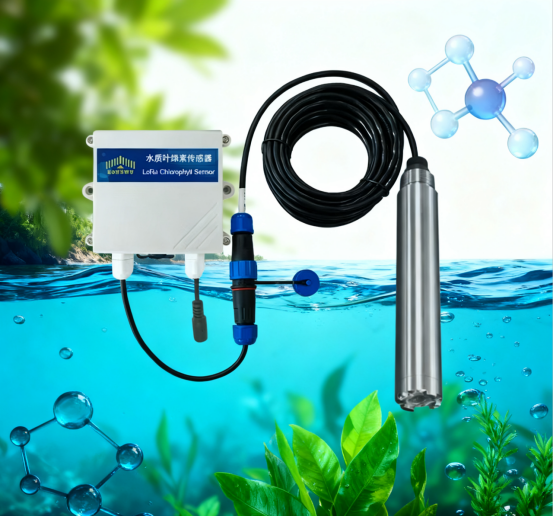
The reason why LoRaWAN water quality chlorophyll sensors can subvert traditional monitoring models lies in the perfect combination of professional detection technology and low-power communication technology, solving the three core problems of "inaccurate measurement, short transmission distance, and short service life".
1. Fluorescence Detection, Data Accurate to "Microgram Level"
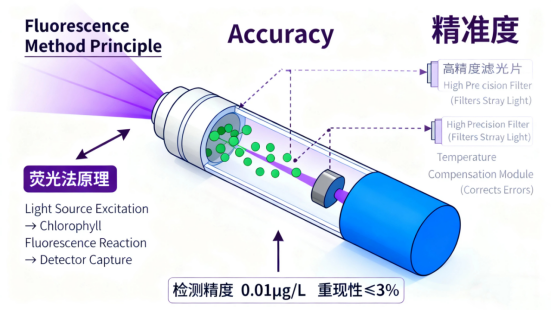
The sensor adopts the industry mainstream fluorescence detection principle: chlorophyll in water is excited by LED light sources of specific wavelengths to produce fluorescence reactions, and the fluorescence signals are captured by high-sensitivity detectors. To avoid interference from turbidity, water temperature and other factors, the equipment is equipped with double guarantees: high-precision optical filters can filter stray light, and temperature compensation modules can automatically correct errors caused by water temperature changes. Practical tests show that its detection accuracy can reach 0.01μg/L with a reproducibility of ≤3%, which can accurately capture even subtle fluctuations in chlorophyll concentration, providing reliable basis for algal bloom early warning.
2. Low Power Consumption & Wide Transmission, "Zero Burden" in Remote Scenarios
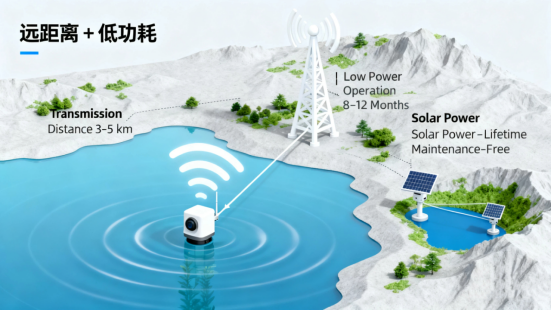
Relying on the technical advantages of the LoRaWAN protocol, the sensor has achieved a dual breakthrough in "long-distance + low power consumption". In terms of communication, it supports global mainstream frequency bands such as 470MHz, 868MHz, and 915MHz, with a transmission distance of 3-5 kilometers in open environments. Even around lakes with dense trees or water plants surrounded by buildings, stable data transmission can be achieved through gateways. In terms of power consumption, the power consumption is only tens of milliamps when actively uploading data, and as low as microamp level in sleep mode. Equipped with a lithium battery, it can work continuously for 8-12 months; with an optional solar module, it can even achieve "lifetime maintenance-free power supply", completely getting rid of dependence on the power grid.
3. Industrial-Grade Protection, "Stable Operation" in Harsh Environments
Aiming at the complex outdoor water environment, the sensor has made sufficient efforts in structural design. The shell is made of 316L stainless steel with an integrated molding process, reaching IP68 protection level, which can be completely submerged in water 5 meters deep for long-term work. Its corrosion resistance is suitable for various scenarios such as fresh water, sea water and industrial wastewater. At the same time, the equipment can withstand a wide temperature range of -20℃ to 80℃, and can operate stably whether in frozen reservoirs in northern winter or high-temperature fish ponds in southern summer. Some models are also equipped with ultrasonic automatic cleaning functions, which automatically clean algal attachments on the probe surface every 24 hours, extending the manual maintenance cycle from once a month to once a quarter.
Widely Applied in Scenarios from Government to Enterprises.
With its outstanding performance advantages, LoRaWAN water quality chlorophyll sensors have been applied in multiple fields, becoming "water quality managers" for different users:
Municipal Water Conservancy: Early Warning to Protect Basin Ecology
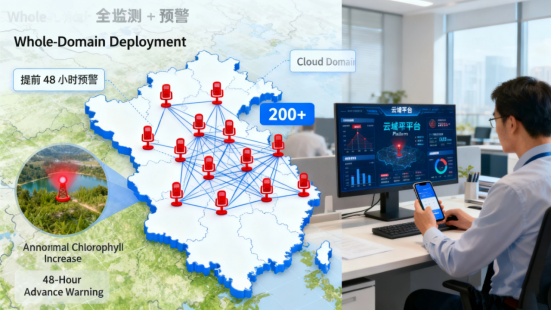
A provincial water conservancy department has deployed sensors in more than 200 key lakes and rivers within its jurisdiction, building a global water quality monitoring network. This summer, the system detected abnormal increase in chlorophyll concentration and issued an early warning 48 hours in advance of an algal bloom in a lake. Relevant departments promptly launched ecological water transfer, reducing disaster losses by 80%. Data is uploaded to the cloud platform in real time, and managers can check the global water quality status through computers or mobile phones, greatly improving management efficiency.
Waterworks: 24/7 Monitoring to Ensure Drinking Water Safety
A large waterworks in southern China has installed 12 sensors at the water intake and surrounding waters to monitor chlorophyll and cyanobacteria concentrations 24 hours a day. When the data exceeds the early warning threshold, the system will immediately trigger a linkage mechanism: on the one hand, send SMS reminders to the waterworks operation and maintenance personnel; on the other hand, automatically feed back to the purification workshop to adjust the dosage of coagulants. This measure not only prevents algal toxins from entering the drinking water pipe network, but also reduces chemical costs by 15%.
Aquaculture: Scientific Management to Improve Breeding Benefits
A Penaeus vannamei breeding base in Shandong has deployed 30 sensors to monitor the chlorophyll concentration in the breeding ponds in real time. Farmers can check the data through a mobile APP. When the concentration is too high, they promptly turn on the aeration equipment and reduce the feeding amount, effectively avoiding the death of fish and shrimp due to hypoxia. After applying the sensors, the survival rate of Penaeus vannamei in the base increased from 65% to 82%, and the average income per mu increased by nearly 3,000 yuan (about 415 US dollars).
Industrial Environmental Protection: Real-Time Monitoring to Reduce Compliance Risks
A chemical enterprise has installed sensors at its wastewater discharge outlets to monitor the chlorophyll concentration in the discharged water in real time, ensuring that the discharged water quality meets the "Comprehensive Wastewater Discharge Standard". The equipment is connected to the monitoring platform of the local environmental protection department, and data is shared in real time, which not only avoids wastewater pollution to surrounding water bodies, but also reduces the risk of environmental protection penalties, achieving a win-win situation for enterprise environmental protection and production.
Choose the Right Sensor, Double the Efficiency of Water Quality Management
Faced with many sensor products on the market, many users will fall into "choice difficulties". In fact, you only need to focus on three core dimensions: first, detection accuracy, and priority should be given to products with resolution ≤0.01μg/L and reproducibility ≤3%; second, communication stability, confirm that the product supports local mainstream LoRaWAN frequency bands and has anti-interference capabilities; third, after-sales service, choose brands that can provide installation guidance, data interpretation and fast fault response.
We have been deeply engaged in the water quality monitoring field for 8 years. Our LoRaWAN water quality chlorophyll sensors have passed the relevant testing and certification of the Ministry of Water Resources of China, serving more than 300 water quality monitoring projects across the country. Whether it is a government basin management project or an enterprise production and operation demand, we can provide full-process customized solutions from sensor selection, network planning to platform construction.
Contact us now to get free on-site survey and scheme design services. Let the LoRaWAN water quality chlorophyll sensor be your "water quality detective", and say goodbye to the "sudden attack" of water quality hazards!
Contact: Qui
Phone: 18146178586
Tel: 18146178586
Email: qui@zonewu.com
Add: 1501-3, Building F03, Phase III, Software Park, Jimei District, Xiamen City, Fujian Province, China