Welcome: Xiamen ZoneWu Technology Co., LTD.

qui@zonewu.com
18146178586
Amid the wave of globalization, China-made water quality monitoring equipment is accelerating its entry into the global market. Among them, solar-powered water total hardness sensors, which integrate renewable energy and Internet of Things (IoT) technologies, are highly popular in the European market thanks to their advantages of cable-free operation and intelligent monitoring.
However, the European market, though vast, has extremely high entry barriers. For solar-powered water quality sensors, two crucial "passports" are mandatory for smooth customs clearance and inclusion in EU customers’ procurement lists: CE certification and RoHS certification. Today, we will conduct an in-depth analysis of these two core standards.
The EU has established a complete set of technical regulations to ensure the safety, environmental friendliness and health compliance of imported products. Any electrical and electronic equipment equipped with wireless communication functions, or powered by mains electricity, batteries (including solar energy), is subject to these two regulations.
CE Certification: Regarded as the "passport" for products entering the EU market, it certifies that the product meets the EU’s basic requirements for safety, health, environmental protection and other aspects.
RoHS Certification: Focused on "environmental protection", it specifically restricts hazardous substances in electrical and electronic products, aiming to reduce the pollution of soil and water sources by electronic waste.
Without these two certifications, your solar-powered hardness sensors will not only be detained at customs, but may also face heavy fines and even be blacklisted.
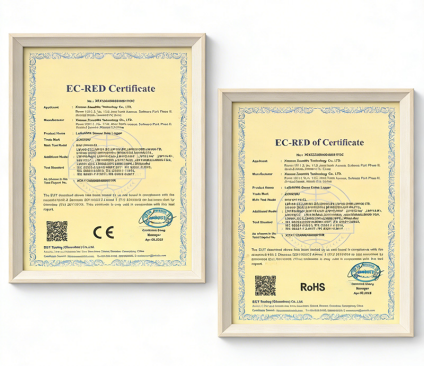
What aspects do CE and RoHS evaluate specifically for solar-powered water total hardness sensors?
CE certification is a comprehensive mark. For our sensors, it mainly involves the following directives:
EMC (Electromagnetic Compatibility Directive, 2014/30/EU):Solar-powered water quality sensors are usually equipped with wireless data transmission modules (such as NB-IoT, LoRa). The EMC Directive requires that the equipment must not interfere with other surrounding electronic devices (e.g., PLCs in industrial sites) during operation, and must also have anti-interference capabilities to withstand external electromagnetic environments and ensure the measurement accuracy of hardness values.
LVD (Low Voltage Directive, 2014/35/EU):This relates to the operational safety of the equipment. The internal circuit design, insulation performance of the sensor, especially the charge-discharge management of solar panels and energy storage batteries, must pass strict tests against electric leakage, short circuits and overheating to prevent safety accidents in harsh outdoor weather conditions.
RED (Radio Equipment Directive, 2014/53/EU):If the sensor is equipped with remote communication functions, it must also comply with the RED Directive to ensure the legal use of wireless frequency bands and that transmission power meets EU standards.
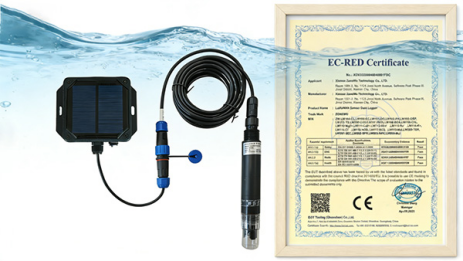
Europe is one of the regions with the strongest environmental awareness in the world. The core of the RoHS Directive (2011/65/EU, the 2nd EU Directive on the Restriction of Hazardous Substances in Electrical and Electronic Equipment) is to limit the content of 10 hazardous substances in electronic devices:
Lead (Pb), Mercury (Hg), Cadmium (Cd), Hexavalent Chromium (Cr(VI))
Polybrominated Biphenyls (PBB), Polybrominated Diphenyl Ethers (PBDE)
4 types of phthalates including Bis(2-ethylhexyl) phthalate (DEHP)
What does this mean for solar-powered water quality sensors?
Circuit Board Soldering: Lead-free processes must be adopted.
Housing Materials: Solar panel frames and plastic parts of sensor housings must not contain excessive flame retardants or plasticizers.
Cables and Sealing Rings: All auxiliary materials must meet environmental protection requirements.
Since sensors need to be immersed in water or installed in humid environments for a long time, their sealing materials and protective coatings must also pass RoHS testing to ensure that no harmful substances are released during long-term use to pollute water bodies—this is particularly critical for sensors monitoring drinking water hardness.
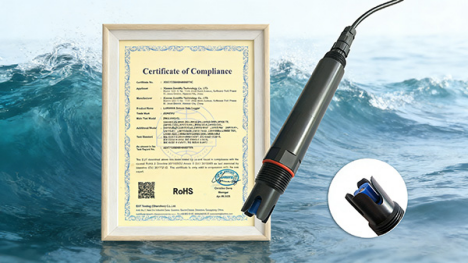
To meet the safety requirements of CE, the environmental requirements of RoHS, and customers’ expectations for "solar self-power supply", manufacturers have made a number of technical improvements:
Low-Power Design: Equipped with ultra-low-power chips and optimized power management algorithms for solar power supply, ensuring stable operation even in cloudy weather.
Anti-Interference Capability: The internal circuits of the sensor are specially shielded and filtered to pass the strict EMC tests in CE certification, ensuring that the RF signals of the wireless communication module do not interfere with the measurement accuracy of the hardness electrode.
Green Material Selection: High-performance engineering plastics and sealing materials compliant with RoHS are selected to ensure environmental protection, as well as resistance to aging and cracking under long-term outdoor exposure and water immersion.
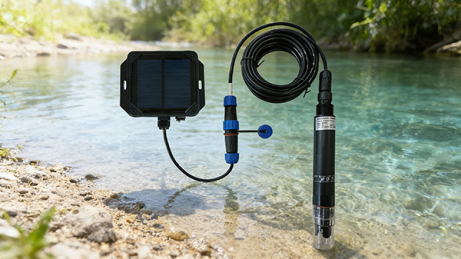
CE and RoHS certifications are indispensable cornerstones for solar-powered water total hardness sensors to gain a foothold in the European market. They are not only mandatory legal requirements, but also authoritative endorsements of product reliability and environmental friendliness.
For manufacturers, obtaining these two certifications means:
Legal Customs Clearance: Smooth access to the markets of all 27 EU member states.
Winning Trust: Proving to European customers that your products are not only technologically advanced, but also safe, eco-friendly and socially responsible.
When green energy (solar power) meets green standards (RoHS) and stringent safety standards (CE), such water quality sensors can truly represent China’s intelligent manufacturing and serve industries and households across Europe.https://www.zonewu.com/en/Water-quality-sensor_1.html
Contact: Qui
Phone: 18146178586
Tel: 18146178586
Email: qui@zonewu.com
Add: 1501-3, Building F03, Phase III, Software Park, Jimei District, Xiamen City, Fujian Province, China