Welcome: Xiamen ZoneWu Technology Co., LTD.

qui@zonewu.com
18146178586
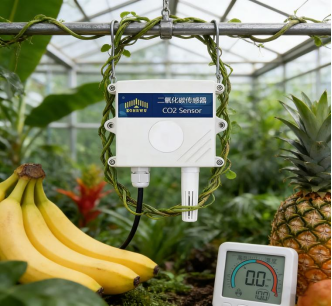
With the rapid development of facility agriculture and smart planting industries, precise monitoring of environmental parameters has become a core link in improving production capacity and ensuring quality. Among them, the real-time control of CO₂ concentration, temperature and humidity directly affects the efficiency of crop photosynthesis and growth cycle. Recently, an RS485 CO₂, temperature and humidity sensor equipped with a new generation of infrared calibration technology has been officially launched on the market. With advantages such as high stability, long service life and strong adaptability, it brings a new environmental monitoring solution to fields such as agricultural planting and facility horticulture.
Technological Innovation: Breaking Through the Bottlenecks of Traditional Sensors
Traditional CO₂ monitoring devices mostly use electrochemical sensors, which generally suffer from problems such as short lifespan, significant long-term drift, and high temperature sensitivity. Frequent calibration and replacement are required, increasing operation and maintenance costs and monitoring errors. The new sensor innovatively adopts infrared calibration technology, fundamentally solving this industry pain point — it not only features fast response speed and high sensitivity, but also achieves the core advantages of low drift and long lifespan. In a 25°C environment, the CO₂ measurement accuracy (high-precision version) can reach ±(45ppm + 3% F·S), and the temperature and humidity measurement accuracies reach ±0.5°C and ±3% RH respectively, fully meeting the precise monitoring needs of professional planting scenarios.
In terms of measurement range, the sensor offers flexible options: the default CO₂ measurement range is 0-5000ppm, with optional 0-2000ppm or 0-10000ppm versions. The temperature and humidity measurement ranges cover -40°C~+80°C and 0~100% RH respectively. Combined with the built-in temperature compensation function, it can maintain data stability even in scenarios with drastic environmental temperature changes, with nonlinear error below 1% F·S.
Adaptability Upgrade: Balancing Convenience and Harsh Environment Adaptability
Targeting the complex installation and usage environment of agricultural sites, the sensor has achieved multiple optimizations in design. In terms of communication, it adopts the standard ModBus RTU protocol, supporting multiple baud rate options (2400bit/s, 4800bit/s, 9600bit/s, etc.; factory default is 4800bit/s). The maximum communication distance can reach 2000 meters, allowing easy access to multi-device bus systems. Moreover, the device address supports custom settings within the 1-254 range to avoid address conflicts.
The power supply and protection design also align with on-site needs: it uses 10-30V DC power supply, with an average current of less than 85mA and a power consumption of only 0.3W (24VDC), adapting to power supply systems in different scenarios. The housing adopts an integrated waterproof structure with a high protection level, enabling stable operation in harsh environments (-20°C~+60°C, 0% RH~95% RH without condensation), perfectly matching multiple scenarios such as agricultural greenhouses, open-air sheds, and edible fungus culture rooms. The installation process is also extremely simple: equipped with a full set of accessories including self-tapping screws and expansion plugs, wall-mounted installation can be completed by drilling 5mm diameter holes, without complex debugging.
Function Expansion: Support for Custom Configuration and Intelligent Linkage
In addition to core monitoring functions, this sensor also features rich expandability to meet personalized needs. The device is equipped with multiple readable and writable registers, and users can modify the upper and lower alarm thresholds and calibration values for humidity/temperature and CO₂ via the 0x06 function code (calibration values are written after being expanded by 10 times). Users can set exclusive monitoring thresholds based on the growth needs of different crops to enable timely alerts for abnormal conditions.
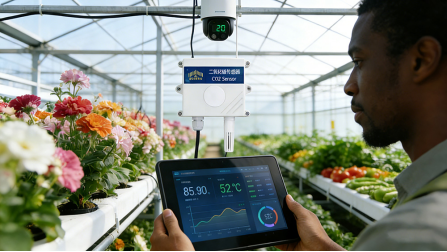
For smart agriculture systems that require multi-parameter integration, the sensor offers two version options: standalone CO₂ monitoring, and integrated temperature-humidity + CO₂ monitoring. The integrated version can retrieve the three core data points (temperature, humidity, CO₂) with a single read operation, and the data update cycle is only 2 seconds. Combined with CRC cyclic redundancy check, it ensures the accuracy and integrity of data transmission, providing reliable data support for IoT platforms and PLC control systems, and helping to implement intelligent control functions such as automated ventilation, fertilization, and irrigation.
Application Scenarios: Covering Full-Scenario Agricultural Planting Needs
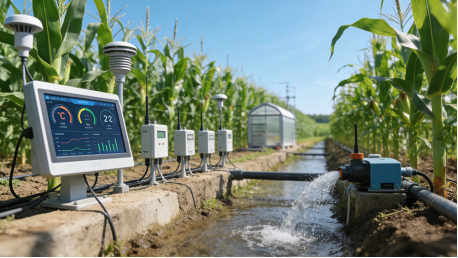
The launch of this sensor will be widely adapted to multiple scenarios such as agricultural greenhouses, flower cultivation, edible fungus planting, and seedling bases. In edible fungus planting, excessive CO₂ concentration inhibits mycelial growth; real-time monitoring via the sensor and linkage with ventilation equipment can control CO₂ concentration within the optimal range. In flower greenhouses, precise control of temperature, humidity, and CO₂ can extend the flowering period and improve flower quality. In large-scale agricultural bases, networked monitoring with multiple devices enables visual management of full-scenario environmental data, providing scientific basis for planting decisions.
Industry Significance: Driving Intelligent Upgrade of Agricultural Monitoring
Currently, smart agriculture is evolving toward the direction of "precision, automation, and low cost." As a data collection terminal, the performance of environmental monitoring equipment directly determines the operational efficiency of intelligent systems. This RS485-type CO₂ temperature-humidity sensor, through technological innovation and scenario adaptation, not only addresses many pain points of traditional devices but also lowers the threshold for intelligent transformation for small and medium-sized planters and large-scale bases with its cost-effectiveness and easy integration.
In the future, as IoT technology deeply integrates with agricultural production, such high-precision and high-stability monitoring equipment will become the core infrastructure of smart agriculture. The launch of this sensor not only fills the market gap for mid-to-high-end agricultural environmental monitoring equipment but also will drive the transformation of facility agriculture from "experience-based planting" to "data-driven planting," injecting new momentum into agricultural yield improvement and sustainable development.
In practical applications, users should avoid installing the device in environments with strong air convection or in contact with organic solvents and corrosive gases. At the same time, ensure the correct wiring of the 485 bus A/B lines, and reasonably set addresses and communication parameters when networking multiple devices, so as to fully leverage the device’s performance advantages.https://www.zonewu.com/en/-Gas-Sensor.html
Contact: Qui
Phone: 18146178586
Tel: 18146178586
Email: qui@zonewu.com
Add: 1501-3, Building F03, Phase III, Software Park, Jimei District, Xiamen City, Fujian Province, China