Welcome: Xiamen ZoneWu Technology Co., LTD.

qui@zonewu.com
18146178586
Worried about fish and shrimp seedling deaths in aquaculture? Fret over sewage discharge violations in wastewater treatment? Stressed about sensor frequency mismatches in cross-border projects? The right all-in-one water quality EC (Electrical Conductivity) sensor is the one-stop fix for all these issues.
Boasting global frequency band adaptation, full-scenario compatibility, and reliable accuracy with long-lasting performance, the LW100D LoRaWAN Integrated EC Sensor stands out as the top pick for aquaculture, environmental monitoring, and industrial wastewater applications. It is hassle-free, budget-friendly, and a no-brainer buy for your operations.
Full Global Frequency Band Coverage, Hassle-Free Cross-Border Projects
Is frequency band compatibility the biggest headache for your cross-border projects? The LW100D delivers a one-step solution, supporting all mainstream global LoRaWAN frequency bands including CN470, EU868, US915, and AU915. Whether your project is located in China, Europe, North America, or Southeast Asia, the sensor enables seamless access to the local IoT network without any modification or equipment replacement.
Equipped with the standard LoRaWAN 1.0.3 protocol and LoRa TDMA self-organizing network technology, it supports OTAA Class A/C modes with superior signal transmission performance: over 15 kilometers of coverage in suburban areas, and stable transmission ranging from 2 to 5 kilometers in urban areas or factory premises. Even in signal-weak areas such as underground sewage tanks and mountainous water sources, you don’t have to worry about data disconnection, and real-time monitoring remains uncompromised.
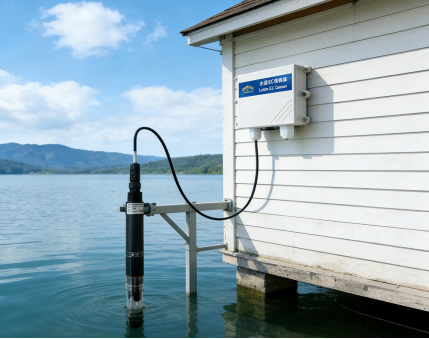
Dual Configurations & Multi-Parameter Support, Adaptable to All Water Quality Scenarios
When selecting an EC sensor, the key factor is its compatibility with different water quality types. The dual-electrode design of the LW100D truly lives up to its reputation as an all-round solution:
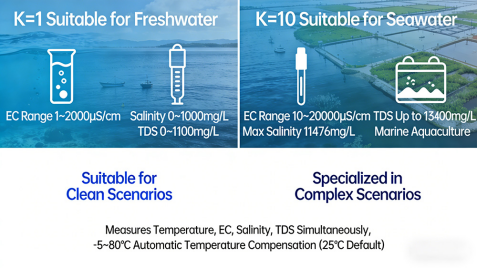
The K=1 electrode is ideal for clean water scenarios such as drinking water and freshwater aquaculture, with an EC measurement range of 1~2000μS/cm, salinity range of 0~1000mg/L, and TDS range of 0~1100mg/L, accurately meeting the monitoring requirements of low-concentration water bodies.
The K=10 electrode is dedicated to complex scenarios including mariculture and industrial wastewater, boasting an EC range of 10~20000μS/cm, a maximum salinity of 11476mg/L, and a TDS level of up to 13400mg/L, enabling precise measurements even for high-concentration sewage.
What makes it even more hassle-free is its capability to simultaneously measure four key parameters: temperature, EC, salinity, and TDS, fulfilling all monitoring needs in one integrated solution. For every 1℃ change in water temperature, the EC value may deviate by approximately 2%. This sensor is equipped with automatic temperature compensation across a wide range of -5~80℃, defaulting to 25℃ as the standard reference temperature, ensuring that data accuracy is never compromised.
High Precision & Durability, Reliable Data Without Misguidance
The quality of a sensor is judged by its accuracy and service life. The LW100D features a temperature measurement error of only ±0.1℃. The K=1 electrode achieves an EC accuracy of 0.1μS/cm, while the K=10 electrode attains 1μS/cm, enabling the accurate capture of even subtle changes in water quality.
Constructed with highly durable platinum material, the electrode boasts a standard service life of up to 1 year, which is 50% longer than that of conventional electrodes. Maintenance is hassle-free when facing issues like organic contamination or calcium-magnesium scaling: wipe off organic pollutants with alcohol and soak to remove limescale in a 10% citric acid solution. Simply avoid touching the platinum black coating on the electrode surface, and you can perform easy on-site maintenance by yourself.
Effortless Installation & Maintenance, Suitable for Complex Environments
No matter how special the installation site is, the LW100D can be easily adapted:
For wall-mounted installation, simply drill a 5mm small hole;
For immersion installation, wrap it with thread seal tape to achieve waterproofing;
For pipeline installation, directly fasten it via the NPT3/4 threaded interface, with no complex construction required.
The standard cable length is 5 meters, and customized lengths are available if needed, eliminating the need to purchase additional extension cords.
Calibration is equally straightforward. Connect the sensor to a computer with a Type-C cable every 3 months, launch the free configuration tool provided by the manufacturer, and complete the process in just a few steps. A single calibration before the first use is sufficient, which saves substantial labor costs compared with traditional sensors.
The device comes with a built-in LED indicator: a flashing green light indicates it is connecting to the network, while a steady green light means the network connection is successful. You can determine the device status without any professional knowledge.
Low Power Consumption & Wide Voltage Range, Stable Operation in Field Scenarios
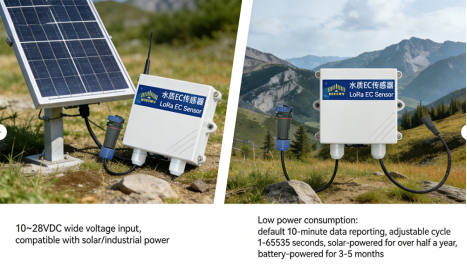
No access to mains power for remote projects? The LW100D supports a wide DC voltage input range of 10~28VDC, and can operate stably when connected to an industrial power supply or solar panel, making it perfectly suited for off-grid field applications.
It delivers outstanding low-power performance: it transmits data every 10 minutes by default, and the reporting interval can be freely adjusted between 1 and 65,535 seconds. Powered by solar energy, it can run continuously for over half a year; when battery-powered, it can last 3–5 months, eliminating the need for frequent battery replacement or recharging.
The King of Cost-Effectiveness, Exceptionally Economical for Long-Term Use
The LW100D adopts an integrated design that includes the sensor, data collector, and Type-C data cable. No additional accessories are required, saving over 2,000 yuan compared with separate purchases. The manufacturer provides a one-year warranty, offering free repairs for non-human-induced damages. The replacement cost of wearing parts such as electrodes is low, which is half the price of that of imported alternatives.
Its protocol interface is open, enabling seamless integration with various IoT platforms without extra development work, thus saving thousands of yuan in system integration costs. Compared with traditional monitoring methods, it can reduce seedling mortality losses in aquaculture and help avoid over-standard discharge fines in wastewater treatment. The investment can be recovered within half a year, making it extremely cost-effective for long-term operation.
Whether for aquaculture, wastewater treatment, drinking water monitoring, or cross-border projects, the LW100D is perfectly adaptable. Boasting global frequency band compatibility, high precision, durability, easy installation and maintenance, as well as maximum cost-effectiveness, orders placed now will enjoy free technical guidance plus an electronic version of the precise calibration tutorial. When selecting a water quality EC sensor, the core criteria are "precision, adaptability, ease of use, and cost-effectiveness" — the LW100D meets all these requirements. Choose the right one once and avoid any pitfalls! https://www.zonewu.com/en/Water-quality-sensor.html
Contact: Qui
Phone: 18146178586
Tel: 18146178586
Email: qui@zonewu.com
Add: 1501-3, Building F03, Phase III, Software Park, Jimei District, Xiamen City, Fujian Province, China