Welcome: Xiamen ZoneWu Technology Co., LTD.

qui@zonewu.com
18146178586
Carbon dioxide (CO₂) monitoring matters across greenhouses, commercial buildings, livestock houses, and warehouses. Elevated CO₂ signals poor ventilation, can hold back crop growth in cultivation rooms, and affects occupant comfort and worker safety. A CO₂ sensor turns that invisible gas into measurable data for demand-controlled ventilation, alarm triggers, and remote cloud monitoring. With wired transmitters and LoRaWAN wireless nodes available, how do you choose? The practical order is: confirm the sensing principle first, then match range and core parameters, and finally decide on communication and alarm functions.
Related product: LW303D LoRaWAN CO2 Sensor
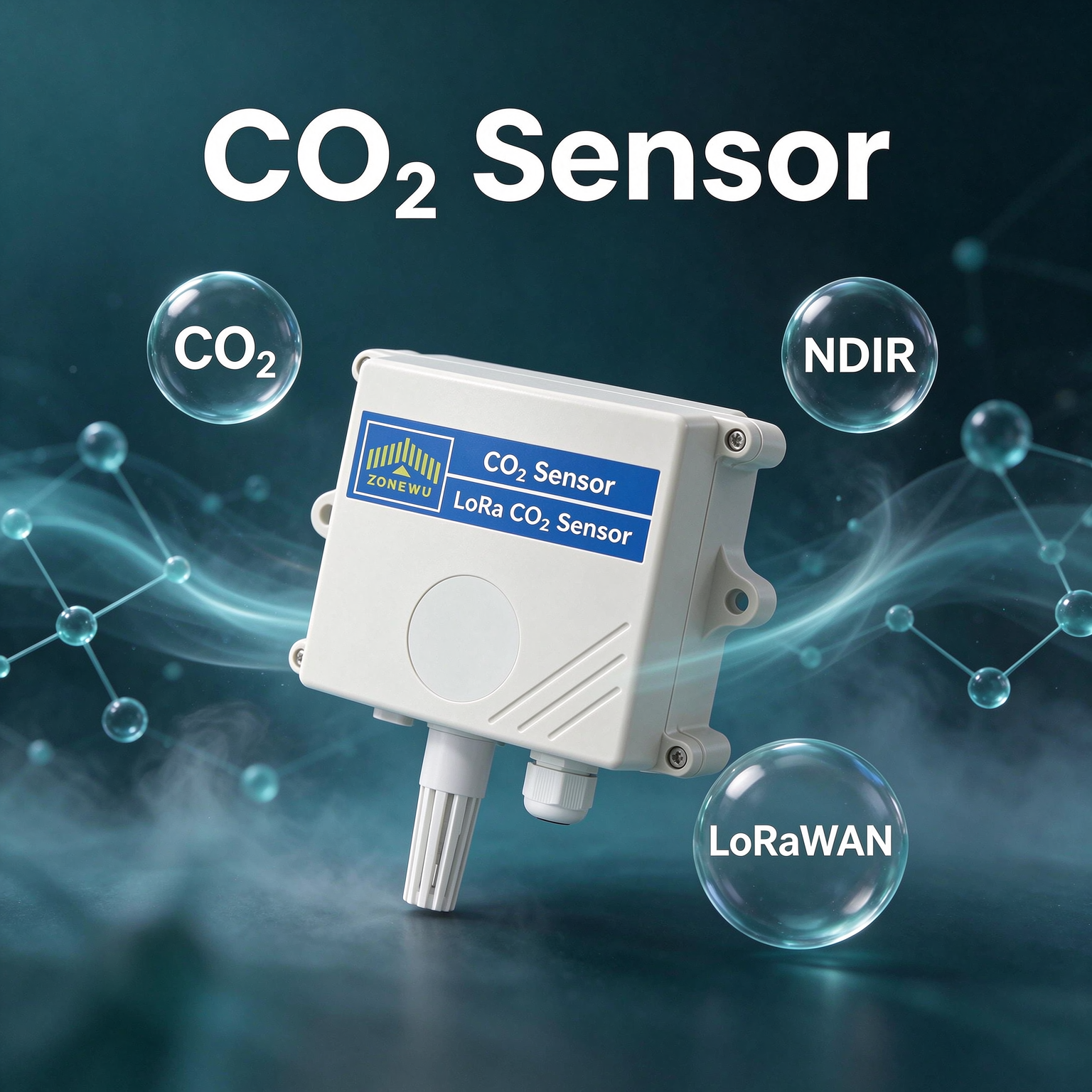
The sensor is the core of a CO₂ monitor. ZONEWU CO₂ products use NDIR (Non-Dispersive Infrared) detection, which measures CO₂ through the characteristic infrared absorption of CO₂ molecules. NDIR operates independently of oxygen, resists sensor poisoning, and keeps a service life above 5 years, which suits continuous indoor air quality and agricultural monitoring.
For continuous CO₂ monitoring in greenhouses, buildings, and barns, an NDIR sensor is the preferred choice for stable readings and long maintenance intervals.
After the principle is confirmed, check the measuring range, resolution, integrated temperature/humidity, supply, and operating environment against your site requirements.
| Model | Principle | CO₂ range | CO₂ resolution / accuracy | Temperature / Humidity | Supply | Communication |
|---|---|---|---|---|---|---|
| LW303D LoRaWAN CO2 Sensor (155) | NDIR | 0–5000 ppm (other ranges on request) | ±50 ppm | -40~+80 °C ±0.3 °C / 0–99.9 %RH ±2 %RH | 5–28 VDC; Type-C for configuration | LoRaWAN 1.0.3, LoRa TDMA; OTAA Class A/C |
| LoRaWAN Wireless CO2 Detector (183) | NDIR | 0–6000 ppm | 1 ppm | -40~+80 °C / 0–99.9 %RH | 5–28 VDC | LoRaWAN, LoRa TDMA; OTAA Class A/C |
| CO2 Transmitter (75) | NDIR | 0–5000 / 0–10000 ppm optional | ±(50ppm+3%FS) @5000; ±(50ppm+5%FS) @10000, 25 °C; nonlinearity <1%FS; response ≤90 s | Standalone CO₂ unit | 10–30 VDC | 4-20mA / 0-5V / 0-10V / RS485 Modbus RTU |

Wired integration. The CO₂ transmitter (75) outputs 4-20mA, 0-5V, 0-10V, and RS485 Modbus RTU to a PLC, DCS, or monitoring software. It suits sites with an existing wired control network and available power.
Wireless LoRaWAN. The LW303D (155) and wireless detector (183) uplink over LoRaWAN to a gateway and the cloud, with OTAA activation and multi-region bands. The reporting cycle defaults to 5 minutes and is configurable; the LW303D provides a transistor (DO) output for alarm or power control, and supports remote restart, threshold, cycle, and calibration settings.
Threshold alarm. Adjustable upper and lower CO₂ limits can trigger an alarm or link to ventilation equipment, so fresh-air control responds before CO₂ builds up.
How long does an NDIR CO₂ sensor last? ZONEWU NDIR models list a sensor life above 5 years; the LW303D carries a 1-year warranty.
Do I need integrated temperature and humidity? For climate rooms and greenhouses, a 3-in-1 node saves a separate T/RH sensor; a standalone CO₂ transmitter is sufficient for basic indoor air quality.
Wireless or wired? Use LoRaWAN when nodes are spread out or cabling is difficult; use RS485/analog when integrating into an existing PLC or DCS.
Which range should I pick? 0–5000 ppm covers indoor air quality and greenhouse use; choose 0–10000 ppm for high-CO₂ industrial conditions.
Start with an NDIR principle for stable, long-life CO₂ measurement, match the range and T/RH integration to your climate goals, and choose LoRaWAN for dispersed nodes or RS485/4-20mA for existing wired control. Browse the ZONEWU CO₂ sensor lineup, LoRaWAN CO₂ sensor, and wireless CO₂ detector, or connect through the IoT Gateway for remote cloud monitoring.
Contact: Qui
Phone: 18146178586
Tel: 18146178586
Email: qui@zonewu.com
Add: 1501-3, Building F03, Phase III, Software Park, Jimei District, Xiamen City, Fujian Province, China