Welcome: Xiamen ZoneWu Technology Co., LTD.

qui@zonewu.com
18146178586
In scenarios such as computer room environment monitoring, pharmaceutical warehouses and intelligent buildings, temperature and humidity data needs to be connected to local area networks (LAN) or cloud platforms for remote centralized management. Compared with traditional RS485 bus solutions, Ethernet temperature and humidity sensors transmit data via existing IP networks across gateways, delivering greater deployment flexibility. Nevertheless, products on the market vary widely in functions. How to make the right choice? This guide elaborates on six key dimensions for your reference.
The core advantage of Ethernet sensors lies in the built-in TCP/IP protocol stack. The following points need to be verified during selection:
Support for static IP and DHCP: Dynamic IP acquisition simplifies configuration, while static IP is ideal for fixed network topologies.
Cross-network segment access and DNS resolution: For data transmission to remote servers or cloud platforms, the device shall support gateway routing and domain name resolution, enabling wide area network (WAN) transmission without a public IP address.
Multi-server upload: Some models can send data to multiple target servers simultaneously, facilitating data backup or distribution to different monitoring systems.
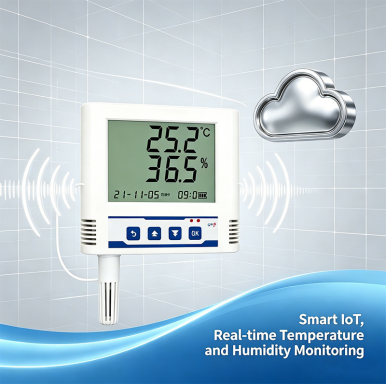
Accuracy Grade: Industrial-grade sensors generally feature humidity accuracy of ±2%~±3%RH (at 25℃, 60%RH) and temperature accuracy of ±0.3℃~±0.5℃. High-precision models (e.g., ±2%RH for humidity) are recommended for precision laboratories and pharmaceutical storage areas, while ±3%RH is sufficient for regular environment monitoring.
Measuring Range: The standard temperature range is -40℃ to +80℃ (custom wider ranges available), and humidity ranges from 0 to 100%RH. Note that the circuit board normally operates at -20℃ to +60℃. The probe can withstand harsher temperatures, so you may extend the probe to the monitored area and place the main unit in a mild environment.
Ethernet sensors commonly support wide-range DC power input (7~30V DC) with low typical power consumption of 0.7W. A power adapter is optional if no DC power is available on site. Not all models support Power over Ethernet (PoE). Prioritize PoE-enabled sensors if you require simplified wiring.
Relay Output: Most devices come with 1 to 2 normally open contacts, which can be triggered by high/low temperature or humidity alarms to directly control exhaust fans, heaters, sound-light alarms without relying on upper computers.
Built-in Buzzer: It provides on-site audible and visual alerts to help inspectors quickly locate abnormal points. Check for external alarm interfaces if high-power external alarm devices are needed.
Configuration Methods: Products with dedicated network search software are preferred. They can be automatically detected within the same LAN, allowing users to modify IP addresses, target server addresses, ports and other parameters without serial cables or physical button menus.
Physical Buttons and Display Screen: Devices equipped with local LCD screens enable on-site viewing of real-time temperature, humidity and alarm status. However, physical buttons are inconvenient for sensors installed at heights or in enclosed spaces, so remote configuration capability shall be prioritized in such cases.
Data integrity is critical for key monitoring scenarios. Pay attention to the following features:
On-board Storage: Some sensors support local data logging (up to 65,000 data sets). They cache data during network outages and automatically resume transmission once the network recovers.
Adjustable Upload Interval: The upload interval is configurable from 1 second to 10,000 seconds. A short interval (≤5 seconds) suits environments with rapidly changing parameters, while a long interval is fit for long-term trend monitoring.
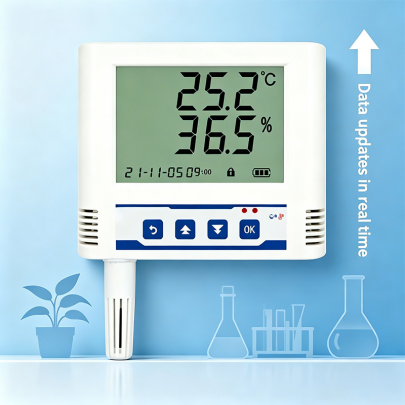
Ethernet temperature and humidity sensors excel at remote centralized monitoring. When selecting products, give top priority to network compatibility and alarm linkage performance, and then make comprehensive decisions based on required accuracy and installation conditions. It is advised to purchase samples first and test device discovery, data upload and alarm output stability within the local network, to ensure seamless connection with your existing monitoring platform.
https://www.zonewu.com/en/temperature-and-humidity-probe-sensor.html
Contact: Qui
Phone: 18146178586
Tel: 18146178586
Email: qui@zonewu.com
Add: 1501-3, Building F03, Phase III, Software Park, Jimei District, Xiamen City, Fujian Province, China